
Texas Commercial Electricity for Small & Large Businesses

We compare rates and services from top 25 electricity suppliers in Texas to build a custom business electricity plan that fits your usage, budget, and growth goals


Upload your bill

Commercial Electricity Plans Built for Your Business

Texas businesses can choose between three commercial electricity rate structures. Each carries a different mix of price certainty, market exposure, and budgeting flexibility — and the right one depends on your load profile, contract appetite, and tolerance for ERCOT price volatility.

Fixed Rate

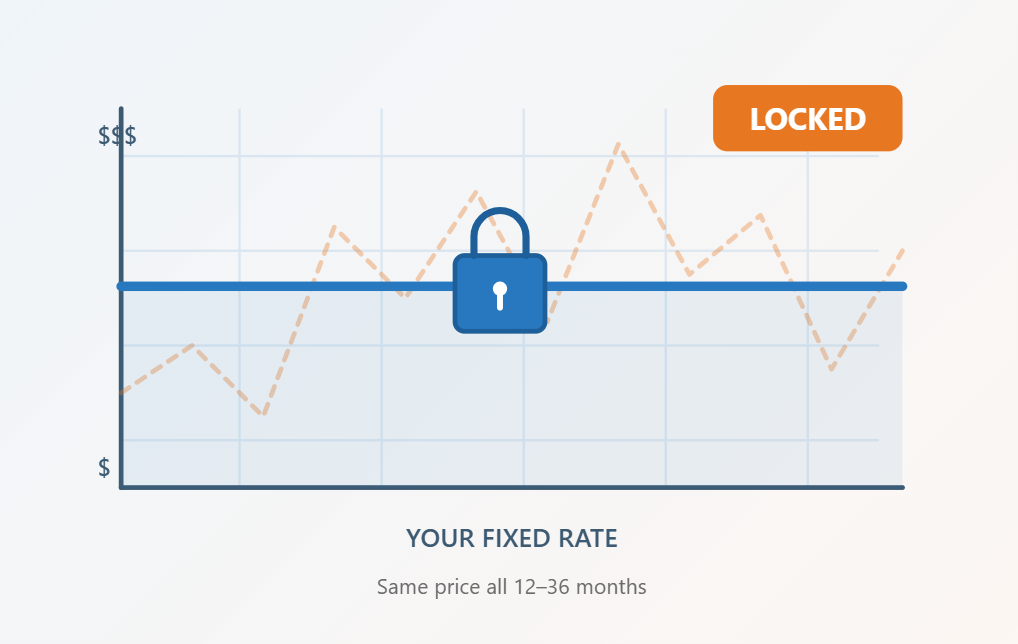
A fixed-rate commercial electricity contract locks in your generation price per kilowatt-hour for the entire term — typically 12, 24, or 36 months. Your monthly bill still reflects how much electricity you actually use, but the rate itself stays constant regardless of what happens in ERCOT, the weather, or natural gas markets. For most Texas businesses this is the simplest and safest path: predictable budgeting, no surprises during peak summer load events, and clean line-item accounting. The trade-off is that fixed rates carry a small premium over the prevailing index, because the supplier is taking on the market risk on your behalf. We negotiate term length, contract clauses, and renewal windows to make sure you're locking in at the right time — not just any time.


Best for: Small and medium businesses, multi-site retailers and franchises, budget-driven operations, anyone who needs zero billing surprises.
Hybrid Rate

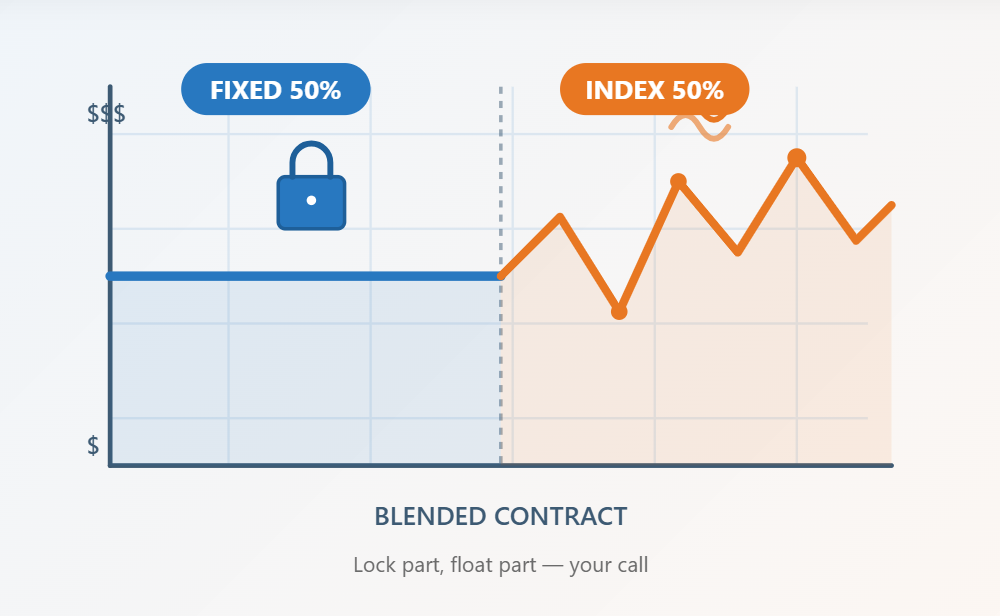
Hybrid commercial electricity contracts blend fixed and indexed pricing under a single agreement, letting you lock in a portion of your expected load at a fixed rate while floating the remainder against the wholesale market. You get price certainty on your baseline consumption — protecting against worst-case scenarios — while still capturing market upside on the variable portion. Hybrid structures are typically configured as 50/50, 70/30, or custom splits, and many include the option to convert floating volume to fixed mid-term if the market moves in your favor. This is the approach used by sophisticated commercial buyers and energy managers who want to actively manage cost risk rather than commit fully to one strategy. We model your historical load curve, recommend the right split, and handle the ongoing strategy as conditions change.


Best for: Mid-to-large operators, businesses with variable seasonal load, energy-conscious organizations that want flexibility without abandoning price protection.

Our Trusted Partners

How It Works

Three steps to lower electricity costs across your apartment portfolio — we handle the energy market, you manage your communities.

Send Us Your Bills

Upload your electricity bill so we can see your usage history.

We Shop & Compare

We run your usage against 25+ Texas suppliers and present the best fixed, indexed, and hybrid options for your business.


You Sign & Relax

Pick your plan, sign electronically, and we handle the switch end-to-end. Zero service interruption, ongoing support.

Business We Serve

Texas Cities We Serve

Commercial electricity procurement across every major deregulated city in the Texas ERCOT market. Wherever your business operates, we can shop the market for you.

  • Houston
  • Plano
  • Frisco
  • Mesquite
  • Lewisville
  • League City
  • Odessa
  • Katy
  • Coppell
  • Dallas
  • Corpus Christi
  • McKinney
  • Carrollton
  • Round Rock
  • Sugar Land
  • Abilene
  • Texas City
  • Burleson
  • Fort Worth
  • Lubbock
  • Pasadena
  • Midland
  • Pearland
  • Mansfield
  • Victoria
  • Rowlett
  • Richardson


  • Arlington
  • Irving
  • Killeen
  • Waco
  • Tyler
  • Wichita Falls
  • San Angelo


Commercial Electricity FAQs

Answers to the questions Texas businesses ask most about commercial electricity rates, contracts, and the procurement process.

  • How is commercial electricity different from residential in Texas?

    Commercial electricity contracts in Texas are negotiated based on your business's actual usage profile — including kWh consumption, peak demand (kW), load factor, and operating hours. Unlike residential plans, commercial rates aren't published on Power to Choose; instead, brokers and suppliers price each contract individually based on your TDU territory, contract length, and load shape. Commercial bills also include demand charges, TDU pass-through fees, and non-bypassable utility charges that work differently than what you'd see on a home electric bill. LeeBroker Services helps navigate these complexities, ensuring you secure the best pricing and contract terms based on your facility's needs.

  • What contract length should my business choose for electricity?

    The right term depends on where the market is and how much price stability your business needs. In a falling market, shorter 12-month contracts let you re-shop sooner. In a rising market, locking in 24 or 36 months protects you from future increases. Most Texas businesses we work with land on 24 or 36 months because it balances rate competitiveness with budget predictability. LeeBroker Services models both scenarios for every client before signing.

  • What's the difference between fixed, indexed, and hybrid commercial electricity plans?

    A fixed-rate plan locks your generation price for the full contract term, so your rate per kWh never changes. An indexed plan ties your rate to the wholesale ERCOT market — it can be lower on average but moves up and down monthly. A hybrid plan blends the two: part of your load is fixed, part floats with the market, giving you both protection and flexibility. The right choice depends on your usage profile, risk tolerance, and how actively you want to manage energy costs. LeeBroker Services models each option based on your specific needs to help you make the most informed decision.

  • How do energy brokers like LeeBroker Services get paid?

    We're paid directly by the Retail Electric Provider you ultimately sign with — not by you. The fee is a small fraction of a cent per kWh, fully disclosed, and built into the rate the supplier quotes. You pay nothing for our shopping, contract analysis, or ongoing account management, and you'll never receive a separate invoice from us. Because we work with 25+ suppliers, we have no incentive to push one over another — our job is finding you the best fit.

  • Can I switch providers if I'm currently under contract? When should I start shopping?

    Yes — Texas suppliers offer "future-dated" contracts that begin the day after your current contract expires, with no early termination penalty. The sweet spot for shopping a new commercial electricity contract is 6 to 12 months before your current term ends. That gives us a full window to monitor the market, identify favorable pricing dips, and lock in a rate before your current supplier auto-renews you onto a higher hold-over rate.

  • What is a Letter of Authorization (LOA) and is it binding?

    A Letter of Authorization is a standard industry form that gives us permission to request your historical electricity usage data from your local TDU (the wires company). It does not commit you to switching providers, signing a contract, or paying anything. It only lets us pull the 12-month usage history we need to get accurate quotes from suppliers. You can revoke it at any time.

  • What are demand charges and how do they affect my commercial electricity bill?

    Demand charges are billed based on your highest 15-minute peak power draw (measured in kW) during the billing period, not your total energy consumption. For many commercial customers, demand charges can account for 30–50% of the total bill. Reducing your demand peaks — by shifting equipment runtime, staggering startups, or adding load controls — can dramatically lower your overall electricity costs even without changing your supply rate. LeeBroker Services analyzes your demand profile to help optimize your electricity consumption and minimize these charges.

  • How does my building's load profile affect my electricity rate?

    Suppliers price commercial contracts based on how predictable and "well-shaped" your usage is. A business that consumes electricity steadily across the day and week — like a warehouse or data center — is cheaper for a supplier to serve, so it gets better rates. A business with sharp peaks during high-cost ERCOT hours, like a restaurant during dinner rush in August, is more expensive to hedge and pays a premium. LeeBroker Services analyzes your load profile and matches you with the suppliers that price your exact shape most aggressively.

  • Do I need a separate contract per location for multi-site businesses?

    Not necessarily. Multi-site businesses can usually consolidate all locations under a single master commercial electricity agreement, which simplifies billing, gives you one renewal date, and improves your buying power because suppliers price aggregated load more aggressively. LeeBroker Services handles aggregated procurement for retail chains, restaurant groups, multi-family operators, and franchise owners across Texas regularly.

  • What happens at the end of my commercial electricity contract?

    If you don't sign a new contract before your current one ends, your supplier will move you onto a "hold-over" or month-to-month rate — which is almost always significantly higher than what you were paying. This is one of the most common (and most expensive) mistakes commercial energy buyers make. LeeBroker Services tracks every client's contract end date and proactively re-shops the market before the renewal window closes, so you're never caught flat-footed.

Energy Insights

Browse Energy Topics

Deeper guides on the parts of Texas commercial energy most relevant to operators in this industry.

Energy Savings

Demand management, rate shopping, and bill audtis.

Explore guides →

Rate Structures

Fixed, index, variable, and hybrid plans compared.

Explore guides →

Energy Basics

Deregulation, REPs, TDUs, ERCOT, and how to read your bill — the foundation every Texas energy buyer needs.

Explore guides →

Contract Strategy

Renewal timing, holdover rates, and broker vs direct procurement.

Explore guides →

Expert Guide

ERCOT mechanics, load factor, capacity charges, PPAs and hedging.

Explore guides →