
Fixed Rate Commercial Electricity Plans in Texas: The Complete Guide for Business Owners
A fixed rate electricity plan is the most common contract structure for Texas businesses — and for good reason. It locks in your energy charge at a set price per kilowatt-hour for the entire length of your contract, giving you the kind of cost predictability that makes budgeting, forecasting, and financial planning significantly easier. No matter what happens in the ERCOT wholesale market — whether prices spike during a July heat wave or collapse during a mild spring — your rate stays the same.
But "fixed rate" is not as simple as it sounds. The rate you lock in depends on when you sign, how long you commit, which REP you choose, and how well you understand the components that make up your total cost. A business that locks in at the right time on the right terms can save tens of thousands of dollars over a multi-year contract. A business that locks in blindly — signing whatever their current provider offers two weeks before expiration — often pays far more than necessary.
This guide covers everything a Texas business owner or operator needs to know about fixed rate commercial electricity plans: how they are priced, when to lock in, how long to commit, what to watch for in the contract, and how to make sure you are getting the best deal available.
How Fixed Rate Electricity Plans Work
When you sign a fixed rate contract, your REP (Retail Electric Provider) guarantees that the energy charge on your bill will remain at the agreed-upon price per kWh for the entire contract term. If you lock in at 7.2 cents per kWh on a 24-month contract, you will pay 7.2 cents per kWh for every unit of electricity you consume over those 24 months.
Behind the scenes, your REP is taking on price risk on your behalf. They need to purchase electricity from the wholesale market to serve your load, and wholesale prices change constantly — sometimes dramatically. To guarantee your fixed rate, the REP uses a combination of forward contracts, financial hedges, and bilateral purchase agreements to lock in their own supply costs for the duration of your contract. The difference between what they pay for wholesale electricity and what they charge you is their margin.
This is an important concept to understand: your fixed rate is not random. It is derived from the current wholesale forward curve (the market's best estimate of future electricity prices) plus the REP's operating costs, risk premium, and profit margin. When wholesale forwards are low, fixed rates are low. When forwards are elevated — typically heading into summer or during periods of high natural gas prices — fixed rates go up.
This means the rate you are offered today may be materially different from the rate offered two months from now. It also means that two different REPs quoting for the same contract term and start date will often offer different rates, because they have different wholesale procurement costs, risk appetites, and margin targets.
What Is Actually "Fixed" in a Fixed Rate Plan
This is where many business owners get tripped up. A "fixed rate" does not necessarily mean your total bill will be the same every month. Here is what is typically fixed and what is not:
What Is Fixed
- Energy charge per kWh — The core rate you negotiated. This is the component that tracks wholesale electricity prices, and it is locked for the contract duration.
- REP margin/adder — The REP's fee on top of the wholesale energy component. In a fixed rate contract, this is embedded in the locked rate.
What May Not Be Fixed
- TDU delivery charges — The fees from your local Transmission and Distribution Utility (CenterPoint, Oncor, AEP, TNMP) for using the wires. These are regulated by the Public Utility Commission of Texas and can change, typically once or twice per year. Most commercial contracts pass TDU charges through at cost, meaning they are not included in your "fixed" rate.
- Demand charges — If your business is on a demand-metered account (most commercial accounts above 10 kW), your demand charge is based on your peak usage in any given billing period. This varies month to month based on your consumption patterns, not market prices.
- Ancillary service charges — Some contracts pass through ERCOT ancillary service costs separately. Others bundle them into the fixed rate. Read the contract to know which structure you are getting.
- Taxes and regulatory fees — State and local taxes, the System Benefit Fund charge, and nuclear decommissioning fees are typically passed through and can change based on regulatory action.
The critical distinction is between "all-in" (bundled) fixed rates and "energy-only" fixed rates. An all-in rate of 8.5 cents per kWh includes TDU delivery, ancillary services, and most fees. An energy-only rate of 5.5 cents per kWh looks cheaper on paper but will result in a total cost of 8-10 cents per kWh once TDU and other charges are added. When comparing quotes from different REPs, always confirm whether the rate is all-in or energy-only — this is the single most common source of apples-to-oranges comparisons.
Why Most Texas Businesses Choose Fixed Rate
Fixed rate plans dominate the Texas commercial electricity market for several practical reasons that go beyond simple preference:
Budget Predictability
For any business that operates on a budget — which is every business — knowing what your electricity cost per unit will be for the next 12-36 months is enormously valuable. This is especially true for businesses where electricity is a significant operating expense: restaurants, hotels, manufacturing facilities, data centers, and cold storage warehouses.
When you know your rate, you can build accurate financial projections. You can price your products and services with confidence that your input costs will not shift unpredictably. You can present stable operating expense forecasts to investors, lenders, or franchise corporate offices. This stability has real financial value that goes beyond the electricity bill itself.
Protection from Price Spikes
Texas has one of the most volatile wholesale electricity markets in the country. During normal conditions, ERCOT wholesale prices might average $30-$50 per MWh. During a summer heat wave, they can spike to $2,000-$5,000 per MWh within minutes. During extreme events like Winter Storm Uri in February 2021, prices sustained the $9,000/MWh cap for multiple days.
On a fixed rate contract, those spikes are your REP's problem, not yours. Your rate stays the same whether wholesale prices are $20/MWh or $5,000/MWh. This protection is particularly valuable for businesses that consume the most electricity during summer — when wholesale prices are highest — because their peak consumption coincides with peak market risk.
Simplicity
Running a business is complex enough without needing to monitor wholesale electricity markets, understand ERCOT pricing mechanisms, or make daily decisions about energy procurement strategy. A fixed rate plan lets you sign once, know your cost, and focus on running your business for the duration of the contract. There is genuine operational value in simplicity.
Financing and Lease Requirements
Some commercial lease agreements require tenants to maintain fixed rate electricity contracts to ensure predictable operating expenses for the building's financial projections. Similarly, SBA loans and other business financing may factor stable utility costs into their underwriting. A fixed rate contract provides documentation of known future costs that variable rate plans cannot offer.
The Real Costs of a Fixed Rate Plan
Fixed rate plans are not free insurance. The predictability you gain comes at a cost, and understanding these costs helps you decide whether the trade-off is worth it for your business.
The Risk Premium
The most significant cost of a fixed rate plan is the risk premium — the amount your REP charges above expected wholesale costs to compensate for the price risk they are absorbing. This premium is not a line item on your bill. It is embedded in the rate itself.
How large is the risk premium? It varies by market conditions, contract length, and the REP's risk appetite, but it typically adds 5-15% to your rate compared to what you would pay if you could buy at the actual average wholesale price over the same period. During periods of high market volatility — heading into a summer that is forecast to be especially hot, or after a severe weather event — the risk premium increases because REPs face greater uncertainty about their hedging costs.
Over a 24-month contract, a 10% risk premium on a facility consuming 100,000 kWh per month at a base rate of 7 cents per kWh amounts to roughly $16,800. That is the cost of certainty. Whether it is worth paying depends entirely on your business's ability to absorb the alternative: unpredictable monthly bills that could occasionally be dramatically higher.
Opportunity Cost
If wholesale prices decline after you sign your fixed rate contract, you will be paying more than you would on a variable or index rate plan. You cannot benefit from falling market prices because your rate is locked.
This is the fundamental trade-off of any fixed rate instrument. You give up the possibility of paying less in exchange for the certainty of not paying more. Over a multi-year contract, there will inevitably be months where a variable rate would have been cheaper. The question is whether the months where fixed rate protects you from spikes outweigh the months where you overpay relative to the market.
Historical data from ERCOT suggests that in most years, fixed rate customers pay slightly more on average than they would have on a perfectly hedged index product — but in years with extreme weather events (2011, 2019, 2021, 2023), fixed rate customers avoided potentially catastrophic bills that would have wiped out years of savings.
Early Termination Fees
Fixed rate contracts are binding commitments. If you need to break the contract early — because your business is closing, relocating outside the service area, or you found a significantly better rate — you will face an early termination fee (ETF).
ETF structures vary by REP:
- Flat fee: A fixed dollar amount, typically $150 to $295 for commercial accounts.
- Per-month remaining: A charge for each month left on the contract (e.g., $20 per remaining month). A 24-month contract terminated at month 6 with a $20/month ETF would cost $360.
- Liquidation damages: For larger commercial accounts, the ETF may be calculated as the difference between your contracted rate and the current market rate, multiplied by your remaining expected consumption. If the market has moved against you (rates are now lower than your contract), this can be a substantial sum.
Before signing any fixed rate contract, understand the ETF structure. If your business has any chance of relocating, closing, or significantly changing its electricity consumption during the contract term, negotiate the ETF terms or choose a shorter contract length.
When to Lock In Your Fixed Rate
Timing is one of the most underappreciated factors in commercial electricity procurement. The same contract — same REP, same term, same service address — can vary by 15-25% depending on when you sign, because the underlying wholesale forward prices change with market conditions.
The Best Months to Lock In
In the ERCOT market, wholesale electricity prices follow a predictable seasonal pattern:
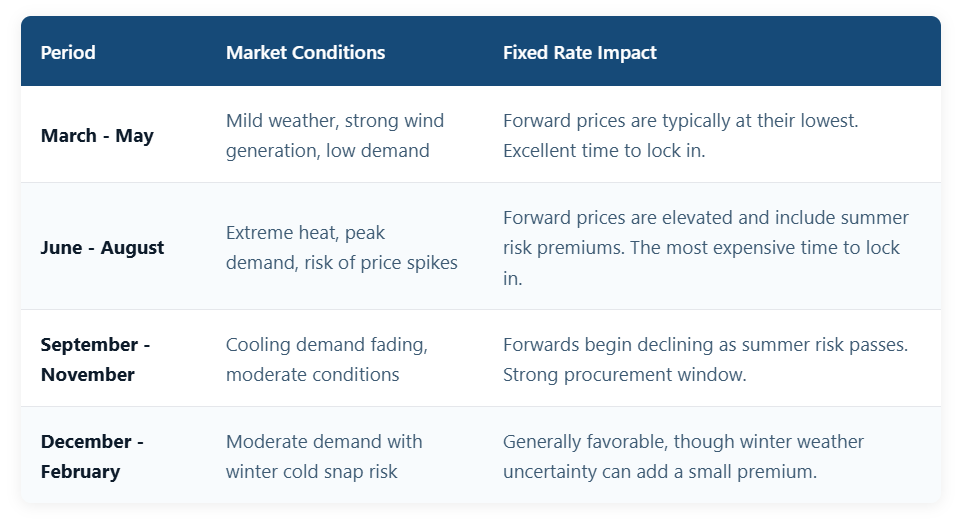
The optimal strategy is to start shopping 3-5 months before your current contract expires, timing your signing to coincide with one of these favorable windows. If your contract expires in August, start soliciting quotes in March or April — before summer premiums build into the forward curve. If your contract expires in March, begin in October or November.
What Drives Short-Term Rate Fluctuations
Beyond seasonal patterns, several factors can cause fixed rate offers to change week to week:
- Natural gas prices — Since gas plants set the marginal price in ERCOT for most hours, movements in the Houston Ship Channel or Henry Hub gas price directly affect electricity forwards. A sustained $0.50/MMBtu increase in gas can add 0.3-0.5 cents per kWh to fixed rate offers.
- Weather forecasts — An updated seasonal weather outlook calling for an unusually hot summer will push summer forward prices up immediately, and that cost flows into any fixed rate contract that covers summer months.
- ERCOT reserve margins — When ERCOT's published reserve margin forecasts tighten (less surplus generation capacity), the market prices in higher scarcity risk, which inflates forward prices and the risk premiums that REPs embed in fixed rates.
- Major grid events — After any significant price spike or grid emergency, REPs tend to increase their risk premiums across the board, even if the event is resolved. This can last weeks to months.
You do not need to become a commodity trader. But understanding these drivers helps you recognize when a rate offer is favorable versus elevated, and it gives you the context to evaluate your broker's recommendation on timing.
The Danger of Waiting Too Long
The single most expensive mistake in commercial electricity procurement is letting your contract expire without a renewal in place. When your fixed rate contract ends, your REP rolls you onto a "holdover" or "month-to-month" rate that is almost always dramatically higher — typically 1.5x to 3x your previous contracted rate.
Holdover rates are expensive because they carry no commitment for the REP. They are buying electricity on short-term or spot markets to serve your load with zero advance planning, and they charge accordingly. Many of the businesses we work with come to us already on holdover rates, paying $0.14-$0.18 per kWh when they could be paying $0.08-$0.10 on a properly negotiated fixed contract.
Your REP is required to send a contract expiration notice, but these notices are easy to miss — especially if they arrive as a single page buried in your monthly bill. Set a calendar reminder 4-5 months before your contract end date. Do not wait for the REP's notice. Read our detailed guide on what happens when your commercial electricity contract expires for the full picture.
How to Choose the Right Contract Length
Fixed rate contracts for commercial accounts are typically available in terms of 12, 24, 36, 48, and sometimes 60 months. The right term depends on several factors:
12-Month Contracts
Best for: Businesses with short leases, uncertain future plans, or those who believe current market prices are elevated and want the flexibility to renegotiate sooner.
Trade-off: 12-month contracts often carry slightly higher per-kWh rates than longer terms because the REP cannot amortize their fixed costs over as many billing cycles. You also face the procurement process every year, which takes time and attention.
24-Month Contracts
Best for: The majority of commercial customers. Provides a meaningful lock-in period with a reasonable commitment. Most competitive from a pricing standpoint — REPs prefer 24-month terms because they offer a good balance between volume certainty and risk horizon.
Trade-off: You are committing for two years. If market prices drop significantly during that period, you cannot take advantage without paying an ETF.
36-Month Contracts
Best for: Businesses that are locking in during a particularly favorable market period and want to capture those low prices for as long as possible. Also good for businesses with long-term leases and stable operations that value set-it-and-forget-it simplicity.
Trade-off: Maximum market timing risk. If you lock in during what turns out to be a market peak, you are paying above-market rates for three full years. The risk premium is also typically higher because the REP is hedging over a longer, less certain time horizon.
Matching Contract Term to Business Circumstances
Beyond market conditions, several business-specific factors should influence your contract length decision:
- Lease term: Never sign an electricity contract that extends beyond your lease. If your lease expires in 18 months, sign a 12-month or 18-month electricity contract. An ETF on an electricity contract you no longer need at a location you have vacated is pure waste.
- Business expansion or contraction plans: If you plan to add a second shift, open an additional location, or make changes that will significantly alter your electricity consumption, a shorter contract gives you flexibility to restructure your electricity procurement to match your new load profile.
- Capital expenditure plans: If you are planning to install solar panels, upgrade to more efficient HVAC equipment, or make other investments that will reduce your electricity consumption, a shorter contract avoids locking in pricing based on your current higher usage.
- Market conditions: If current fixed rates are historically low relative to the 3-5 year average, lean toward a longer term to capture that favorable pricing. If rates seem elevated, lean shorter and plan to renegotiate when conditions improve.
Understanding Your Total Electricity Cost
Your fixed rate per kWh is only one component of your total electricity cost. To truly understand what you are paying — and to compare quotes from different REPs accurately — you need to understand the full cost stack.
The Commercial Electricity Cost Stack
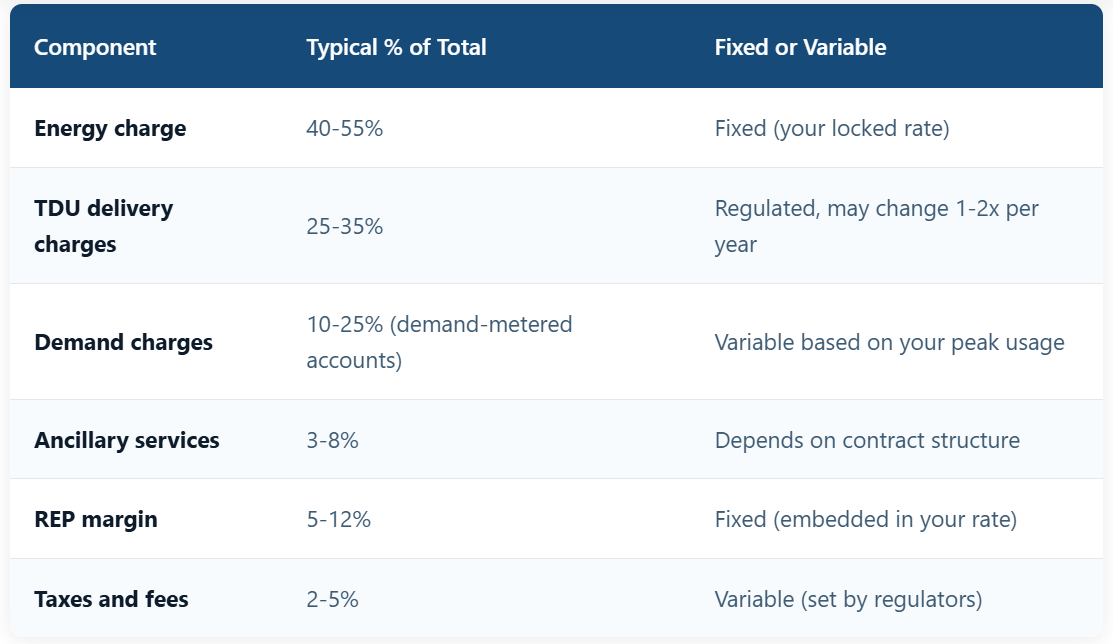
On a demand-metered commercial account, your "fixed" energy rate might represent only 40-55% of your total monthly bill. The rest is composed of charges that can change. This is not a flaw in the fixed rate structure — it is simply how commercial electricity billing works in Texas. But it means that even on a fixed rate plan, your total monthly bill will fluctuate based on how much electricity you use, when you use it (demand charges), and any changes to regulated TDU rates.
All-In vs. Energy-Only Pricing
This distinction is critical when comparing quotes:
- All-in (bundled) pricing: The quoted rate includes energy, TDU delivery, ancillary services, and most fees. What you see is close to what you pay per kWh (though demand charges and taxes may still apply separately). Example: 8.5 cents/kWh all-in.
- Energy-only pricing: The quoted rate covers only the energy charge and REP margin. TDU delivery, ancillary services, and fees are billed separately. Example: 5.2 cents/kWh energy-only, which becomes 8-10 cents/kWh after adding TDU and other charges.
If one REP quotes 5.2 cents energy-only and another quotes 8.5 cents all-in, they may be nearly identical in total cost — or one may be significantly cheaper. You cannot tell without normalizing the comparison. This is one of the most common ways business owners are misled (or mislead themselves) when shopping for electricity. An energy broker ensures all quotes are presented on the same basis.
How to Read Your Commercial Electricity Bill
Every commercial electricity bill in Texas contains the same basic components, though the formatting varies by REP:
- Energy usage (kWh) — Total kilowatt-hours consumed during the billing period. Multiplied by your fixed rate to calculate your energy charge.
- Demand (kW) — Your peak demand in kilowatts during the billing period (demand-metered accounts only). Multiplied by the applicable demand rate to calculate your demand charge.
- TDU delivery — Wires charges from your local utility. Typically a combination of per-kWh delivery charges, demand-based delivery charges, and fixed monthly fees.
- Ancillary and ERCOT charges — Grid reliability and balancing costs passed through from ERCOT.
- Taxes and regulatory fees — State sales tax, System Benefit Fund, nuclear decommissioning.
For a detailed walkthrough, see our guide to reading your commercial electricity bill. Understanding your bill ensures you can verify that your fixed rate is being applied correctly and identify any unexpected charges.
Fixed Rate vs. Variable Rate: A Detailed Comparison
The most common alternative to a fixed rate plan is a variable or index rate plan, where your energy charge fluctuates with the wholesale market. Here is a direct comparison:
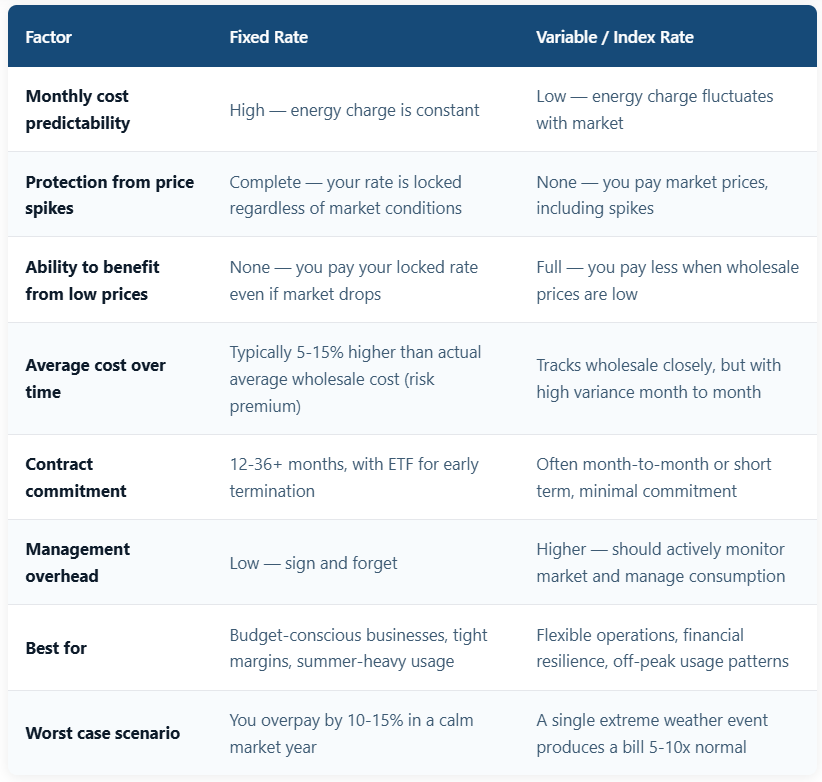
For the majority of Texas commercial customers — especially small and mid-size businesses that cannot dedicate resources to actively managing their energy procurement — a fixed rate plan is the more appropriate choice. The risk premium you pay is effectively an insurance cost, and for most businesses, the cost of that insurance is modest compared to the potential downside of an unhedged market exposure.
Variable and index rate plans can deliver lower average costs over multi-year periods, but they require a business that can tolerate significant bill volatility, has the operational flexibility to shift loads during price spikes, and ideally has someone monitoring market conditions regularly. For a deeper analysis, see our complete comparison of fixed vs. variable rate plans.
How REPs Price Fixed Rate Contracts
Understanding how your REP arrives at the rate they offer gives you leverage in negotiations and helps you evaluate whether an offer is competitive.
The Pricing Formula
A simplified version of how REPs build a fixed rate offer:
Your Fixed Rate = Wholesale Forward Price + Shaping Cost + Ancillary Cost Estimate + Risk Premium + REP Operating Margin
- Wholesale forward price: The cost of electricity for future delivery on the ERCOT forward market. This is the base cost and the largest component. For a 24-month contract, this is the average of forward prices for each month in the contract period.
- Shaping cost: Forward electricity is typically traded as flat "around the clock" blocks, but your business does not consume electricity in a flat block — you use more during the day and less at night, more in summer and less in spring. The cost to "shape" flat block power to match your usage profile adds to the rate. Businesses with peakier usage profiles have higher shaping costs.
- Ancillary cost estimate: The REP's estimate of ERCOT ancillary service and reliability charges over the contract term. In a bundled fixed rate, these are included in the rate. In a pass-through structure, they are billed separately.
- Risk premium: Compensation for the REP bearing the risk that actual wholesale prices will exceed the forward prices they hedged against. This premium increases with contract length, summer exposure, and overall market uncertainty.
- REP operating margin: The REP's costs for customer service, billing, credit management, regulatory compliance, and profit. For a competitive market, this is typically 3-8% of the total rate.
What Makes One REP's Rate Lower Than Another's
When you get quotes from multiple REPs for the same contract, rate differences come from:
- Procurement efficiency: Large REPs with diversified portfolios can hedge more efficiently than small ones. They buy in bulk, use sophisticated financial instruments, and spread risk across thousands of customers. This can translate into lower wholesale procurement costs.
- Risk appetite: Some REPs price aggressively to win market share, embedding a thinner risk premium. Others are more conservative. A thinner risk premium means a lower rate for you, but it also means the REP has less cushion if the market moves against them — which is their problem, not yours.
- Margin targets: REPs competing for your business in a competitive market will sharpen their margins. This is why getting multiple quotes matters — competition directly reduces the margin component of your rate.
- Load profile assessment: A business with a high load factor (flat, predictable consumption) is cheaper for a REP to serve and hedge than a peaky, variable load. If your load profile is favorable, you should be getting a better rate.
- Credit quality: REPs assess the credit risk of commercial customers. A business with strong financials and a track record of paying bills on time may qualify for lower-margin pricing tiers.
How to Negotiate a Better Rate
Armed with an understanding of how rates are built, here are specific negotiation strategies:
- Get multiple competing quotes. This is the single most effective lever. When REPs know they are competing against other offers, they sharpen their pricing. An energy broker can solicit bids from 25+ REPs simultaneously, creating maximum competitive pressure.
- Time your procurement to favorable market conditions. Shopping in September through November or March through April captures lower wholesale forwards, which directly reduces the base cost of every offer you receive.
- Offer volume certainty. If you have multiple locations, offer to aggregate them under one contract. Volume leverage earns tighter margins — a 500,000 kWh/month commitment gets better pricing than a 50,000 kWh/month commitment.
- Negotiate the term that benefits both parties. Most REPs prefer 24-month contracts. Offering to take a 24-month term when you were considering 12 months gives the REP more revenue certainty, which should translate to a margin concession.
- Ask for the rate decomposition. Request a breakdown of the quoted rate into its components (energy, TDU, ancillary, margin). Most REPs will not volunteer this, but brokers can extract it. Knowing the components lets you identify which REP is the most efficient on each element.
- Leverage your load profile. If you have a high load factor, flat usage patterns, or predictable seasonal consumption, highlight this. It makes you a cheaper customer to serve and should be reflected in your rate.
Common Fixed Rate Contract Terms You Need to Know
Beyond the rate itself, several contract terms can significantly affect your total cost and flexibility:
Bandwidth / Swing Tolerance
Some fixed rate contracts include a bandwidth clause that defines how much your actual consumption can deviate from the estimated usage without triggering price adjustments. If you estimated 100,000 kWh per month but consistently use 130,000 kWh, the REP may apply an "over-bandwidth" surcharge because their hedge did not fully cover your actual consumption.
Typical bandwidths are +/- 10% to +/- 20% of estimated monthly usage. If your business has variable consumption (seasonal businesses, growing businesses), negotiate the widest bandwidth possible or choose a contract without bandwidth restrictions.
Renewal and Rollover Terms
Pay close attention to what happens at contract end:
- Auto-renewal: Some contracts automatically renew for a new term (often at a different rate) unless you opt out within a specified window. Know your opt-out deadline.
- Holdover rate: Most contracts roll you onto a month-to-month holdover rate at contract end. These rates are almost always unfavorable. Understand what the holdover rate structure is before you sign.
- Notice period: How far in advance must you notify the REP if you do not intend to renew? Miss this window and you may be automatically enrolled in an unfavorable renewal.
Change of Law / Regulatory Change Provisions
These clauses allow the REP to adjust your rate or add surcharges if regulatory changes (new ERCOT charges, PUC rulings, changes to ancillary service structures) increase their costs of serving your account. Well-drafted contracts limit these adjustments to specific, enumerated regulatory changes. Poorly drafted contracts give the REP broad discretion to pass through virtually any cost increase — which undermines the "fixed" nature of your rate.
Assignment and Transfer
If you sell your business, can the electricity contract be assigned to the new owner? If you relocate to a new address within the same TDU service territory, can the contract follow you? These terms vary by REP and can save you from paying an ETF in situations where your business circumstances change.
Usage Minimums
Some commercial contracts include minimum monthly usage requirements. If your consumption drops below the minimum (due to seasonal closure, equipment efficiency upgrades, or business slowdown), you may still be billed for the minimum amount. This is less common in standard commercial contracts but does appear in large industrial agreements.
Industry-Specific Considerations
The value proposition of a fixed rate plan varies by industry based on usage patterns, seasonality, and operating margins:
Restaurants and Food Service
Restaurants typically consume the most electricity during summer (kitchen equipment + air conditioning) when wholesale prices are also at their highest. A fixed rate plan protects against the worst-case scenario: a summer heat wave that simultaneously drives up your HVAC costs and your per-kWh rate. For a restaurant where electricity is the second-largest expense after labor, a fixed rate is usually the right choice.
Hotels and Hospitality
Hotels have similar seasonal exposure — high occupancy months often coincide with summer, which means peak electricity consumption during peak wholesale price periods. Fixed rates provide the budget stability that hotel operators need for room rate pricing and revenue projections. Multi-property operators should consider aggregating their locations for volume leverage.
Manufacturing and Industrial
Manufacturing facilities with 24/7 operations and high load factors are among the most attractive customers for REPs to serve, which translates to competitive fixed rate pricing. However, these facilities also have the consumption volume where even small per-kWh savings on an index rate can add up to significant dollars. The decision between fixed and index often depends on whether the facility has the operational flexibility to curtail during price spikes.
Retail and Multi-Location
Retail chains and multi-family operators benefit from aggregating multiple meters under a single fixed rate contract. This provides volume leverage for better pricing and simplifies energy management across the portfolio. Fixed rates are particularly valuable for franchise operations where corporate requires consistent financial reporting.
Data Centers
Data centers represent a special case. Their extremely high, consistent load factors make them ideal candidates for competitively priced fixed rate contracts. But their massive consumption volumes mean that even a 0.1 cent/kWh difference between a fixed rate and an average index rate translates to hundreds of thousands of dollars annually. Many data centers use hybrid or block-and-index structures to capture some market upside while maintaining budget predictability on the majority of their load.
The Role of an Energy Broker in Fixed Rate Procurement
An energy broker is an intermediary who shops the market on your behalf, soliciting competitive bids from multiple REPs and presenting them in a standardized format for comparison. For fixed rate procurement specifically, a broker provides several advantages:
- Market access: A broker has relationships with 25+ REPs and can obtain competitive bids from all of them simultaneously. As a business owner calling REPs directly, you might get quotes from 2-3 providers before running out of time and patience. More competition = lower rates.
- Apples-to-apples comparison: Brokers normalize all quotes to the same format — same term, same start date, same pricing basis (all-in or energy-only). This eliminates the comparison confusion that REPs sometimes exploit.
- Market timing advice: Brokers monitor ERCOT wholesale markets and forward curves daily. They can advise you on whether current market conditions favor locking in now or waiting for a better window. This timing guidance alone can save more than the broker's commission.
- Contract review: Brokers understand the fine print — bandwidth clauses, change-of-law provisions, ETF structures, renewal terms. They can flag unfavorable terms and negotiate improvements before you sign.
- No cost to you: Energy brokers in Texas are compensated by the REP, not the customer. The REP pays the broker a commission that is embedded in the rate, similar to how an insurance broker is compensated by the insurance company. Your rate from a broker is typically the same as or better than what you would get going directly to the REP, because the competitive bidding process compresses margins.
Step-by-Step: How to Get the Best Fixed Rate for Your Business
Here is the process we recommend for any Texas business procuring a fixed rate electricity contract:
- Know your contract end date. Check your current bill or contract for the expiration date. Set a reminder 4-5 months before it expires.
- Gather your usage data. Pull your last 12-24 months of electricity bills. You need your monthly kWh consumption and peak demand (kW) to receive accurate quotes. If you do not have your bills, your current REP or TDU can provide historical usage data.
- Contact an energy broker or solicit quotes directly. Provide your usage data, desired contract term, and preferred start date. Request quotes from at least 5-6 REPs — more is better.
- Compare quotes on an all-in basis. Normalize all quotes to the same pricing basis. Compare total estimated annual cost, not just the per-kWh rate. Ask about demand charges, pass-through structures, and any recurring fees.
- Review contract terms before signing. Check the ETF structure, bandwidth provisions, renewal/rollover terms, and change-of-law clauses. Do not sign without understanding what happens at contract end.
- Execute the contract. Sign and return the agreement. Your new rate will take effect on the start date specified in the contract — this is usually your next meter read date after the contract's effective date.
- Set a reminder for the next renewal. As soon as you sign your new contract, set a calendar reminder 4-5 months before the new contract expires. The procurement cycle never ends.
Current Market Context: 2026
As of April 2026, the Texas commercial electricity market reflects the following conditions:
- Average commercial fixed rate: 6.8-7.3 cents per kWh (energy-only) for 24-month contracts. All-in rates are typically 9-11 cents per kWh depending on TDU territory and demand profile.
- Natural gas prices: Houston Ship Channel gas is trading at approximately $2.50-$3.00/MMBtu, which is moderate by historical standards. Gas price stability supports moderate fixed rate pricing.
- ERCOT reserve margins: Summer 2026 reserve margins are projected at approximately 19-22%, which is adequate. This means the scarcity risk premium in current fixed rate offers is moderate.
- Market trend: Forward prices for 2026-2027 delivery are relatively flat, suggesting the market does not expect a significant move in either direction. This is a reasonable environment for locking in — not the lowest rates we have seen, but far from the peaks.
These conditions can change quickly with weather events, gas price movements, or changes in ERCOT's capacity outlook. The data above is a snapshot, not a forecast.
Frequently Asked Questions
What is a fixed rate electricity plan?
A fixed rate electricity plan locks in a set price per kilowatt-hour (kWh) for the entire duration of your contract — typically 12 to 36 months. Regardless of what happens in the wholesale electricity market, your energy charge stays the same every billing cycle. This gives businesses predictable electricity costs for budgeting and financial planning.
When is the best time to lock in a fixed electricity rate in Texas?
The best time to lock in a fixed electricity rate in Texas is during the fall (September through November) and early spring (March through April). During these periods, wholesale electricity demand is low due to mild weather, which pushes forward prices down. Avoid signing fixed rate contracts during June through August when summer heat drives wholesale prices and risk premiums to their annual highs.
How long should I lock in my business electricity rate?
The ideal contract length depends on current market conditions and your business circumstances. If you are locking in during a low-price period (fall or spring), a longer term (24-36 months) captures favorable pricing for more time. If market prices are elevated or you are uncertain about your future occupancy, a shorter 12-month term gives you flexibility to renegotiate sooner. Always align your contract term with your lease term — do not sign a 36-month electricity contract if your lease expires in 18 months.
What happens when my commercial electricity contract expires in Texas?
When your fixed rate contract expires without a renewal in place, your REP will automatically roll you onto a holdover or month-to-month rate. These holdover rates are almost always significantly higher than your contracted rate — often 1.5x to 3x what you were paying. Your REP is required to send a renewal notice before your contract expires, but many business owners miss this window. Start shopping for a new contract 3-5 months before your current one ends.
What is an early termination fee for electricity in Texas?
An early termination fee (ETF) is a penalty charged by your REP if you cancel your fixed rate contract before it expires. For commercial accounts, ETFs typically range from $150 to $295 as a flat fee, or are calculated as a per-remaining-month charge (e.g., $20 per month remaining on the contract). Some REPs calculate ETFs based on the difference between your contracted rate and current market rates multiplied by your remaining expected consumption.
Is a fixed rate or variable rate better for my business?
Fixed rate plans are better for businesses that need budget predictability, operate on tight margins, or use the most electricity during summer months when wholesale prices are highest. Variable or index rate plans can deliver lower average costs over time but expose you to potentially dramatic price spikes during extreme weather or grid stress events. Most businesses — especially those without sophisticated energy management capabilities — are better served by fixed rate plans.
How do I compare commercial electricity rates in Texas?
To compare commercial electricity rates accurately, you need to look beyond the headline cents-per-kWh number. Compare the all-in cost that includes the energy charge, TDU delivery fees, demand charges, ancillary service pass-throughs, and any recurring fees. Request quotes from multiple REPs for the same contract term and start date. An energy broker can solicit bids from 25+ suppliers simultaneously and present them in an apples-to-apples format so you can see the true total cost.
Are TDU charges included in my fixed rate?
It depends on the contract structure. Some fixed rate plans are "all-in" or "bundled," meaning TDU delivery charges are included in the quoted rate. Others quote the energy-only rate with TDU charges passed through separately. Always ask whether a quoted rate is all-in or energy-only, because a 6.5 cent all-in rate is very different from a 6.5 cent energy-only rate where TDU adds another 2-4 cents per kWh. An energy broker can normalize quotes so you are comparing apples to apples.