
Index Rate and Variable Rate Electricity Plans for Texas Businesses: The Complete Guide
Index and variable rate electricity plans are the most sophisticated — and most misunderstood — contract structures available to Texas commercial customers. Where a fixed rate plan locks in your energy charge for the duration of your contract, an index rate plan lets it fluctuate with the wholesale electricity market. The upside is real: businesses on index plans can capture lower average costs during calm market periods, sometimes saving 10-20% compared to what they would have paid on a fixed rate. The downside is also real: during extreme market events, index exposure can produce bills 5-10 times a business's normal monthly cost.
Understanding index rate plans means understanding the ERCOT wholesale market — how prices are set, what drives them, and how wholesale pricing translates into your monthly bill. It also means understanding the significant regulatory changes that followed Winter Storm Uri in February 2021, which reshaped what variable and index products are available to whom and under what conditions.
This guide covers the full landscape of variable and index rate commercial electricity plans in Texas: how they work, who they make sense for, the risks, the regulatory framework, and the hybrid structures that have become the dominant way sophisticated commercial buyers manage wholesale market exposure.
What Is an Index Rate Electricity Plan
An index rate plan ties your energy charge directly to a published wholesale market price index, plus a fixed adder (sometimes called a "heat rate" or "margin") charged by your REP. The formula looks like this:
Your Energy Charge = Wholesale Index Price + REP Adder
For example, if your contract is indexed to the ERCOT day-ahead Houston hub price and your REP charges a $4.50/MWh adder, your energy charge for each hour is the published day-ahead Houston price for that hour plus $4.50/MWh. If day-ahead Houston was $35/MWh on a mild spring day, your rate for that hour is $39.50/MWh. If day-ahead Houston was $450/MWh during a summer afternoon, your rate for that hour is $454.50/MWh.
The critical feature is transparency. Because the index is a publicly published wholesale market price, you can verify every hour of your bill against ERCOT's published data. The REP cannot unilaterally change your rate — only the adder and the settlement methodology are contractual, and the index itself is set by the market.
Variable Rate vs. Index Rate: The Critical Distinction
Many business owners use "variable rate" and "index rate" interchangeably, and in casual conversation this is usually fine. But in commercial contracts, the distinction matters:
Variable Rate Plans
A variable rate plan allows the REP to change your rate based on a methodology disclosed in the contract. The methodology typically references wholesale market conditions, but the REP retains discretion over exactly when and how they pass through market changes. Some variable rate plans are explicit about their pricing mechanism; others are intentionally opaque, giving the REP broad latitude to set rates.
The most problematic variable rate plans are the "default" or "holdover" rates that businesses roll onto when their fixed rate contracts expire without renewal. These rates are variable in the sense that the REP can change them at will, often with minimal notice. They are almost always priced well above actual wholesale costs because the REP has no commitment from the customer and is serving them on a spot basis with short-term procurement.
Index Rate Plans
An index rate plan explicitly ties your rate to a specific, published wholesale market index. The REP does not have discretion — the index is what it is, and your rate is calculated mechanically from it. This is a true market-based product where you bear the wholesale price risk in exchange for wholesale market pricing (plus the REP's adder).
For commercial customers, a true index rate is almost always preferable to a generic variable rate, because you know exactly what pricing formula governs your rate. A variable rate leaves the REP with discretion that they will generally exercise in their own favor.
In this guide, when we refer to "variable rate" we are typically referring to the broader category that includes both true index products and discretionary variable products. The specific contract language determines which flavor you are actually getting.
How ERCOT Wholesale Pricing Flows to Your Bill
To truly understand an index rate plan, you need to understand how ERCOT wholesale pricing works and how it translates into your bill.
The Two ERCOT Markets
ERCOT operates two primary wholesale markets for electricity:
- Day-Ahead Market (DAM): An auction held each day around 10:00 AM where generators and load-serving entities buy and sell electricity for delivery the following day. The DAM clears hourly prices that become the benchmark forward prices for the next 24 hours. Approximately 95% of all ERCOT electricity is financially settled through the DAM.
- Real-Time Market (RTM): A continuous market that dispatches generators every 5 minutes to balance actual supply and demand. When real-time conditions differ from day-ahead forecasts, the RTM adjusts. Real-time prices are far more volatile than day-ahead prices — during extreme events, they can move from $40/MWh to $5,000/MWh within minutes.
When you sign an index rate contract, a critical detail is which market your rate is settled against. A day-ahead settled contract exposes you to volatility in the day-ahead market, which is meaningful but relatively contained. A real-time settled contract exposes you to the full volatility of the 5-minute real-time market, which can be extreme. Some contracts blend the two, using day-ahead for baseload hours and real-time for deviations.
Locational Marginal Pricing
ERCOT is not a single uniform market. Prices vary by location based on transmission constraints. When cheap wind power generated in West Texas cannot be fully delivered to Houston due to transmission line limits, Houston prices are higher than West Texas prices. This geographic price variation is captured in Locational Marginal Prices (LMPs) calculated at thousands of settlement points across the grid.
For an index rate contract, the settlement point determines your actual exposure. ERCOT publishes four main trading hub prices (North, Houston, South, West), as well as prices at specific load zones and individual settlement nodes. The settlement point used in your contract has a direct effect on your rate:
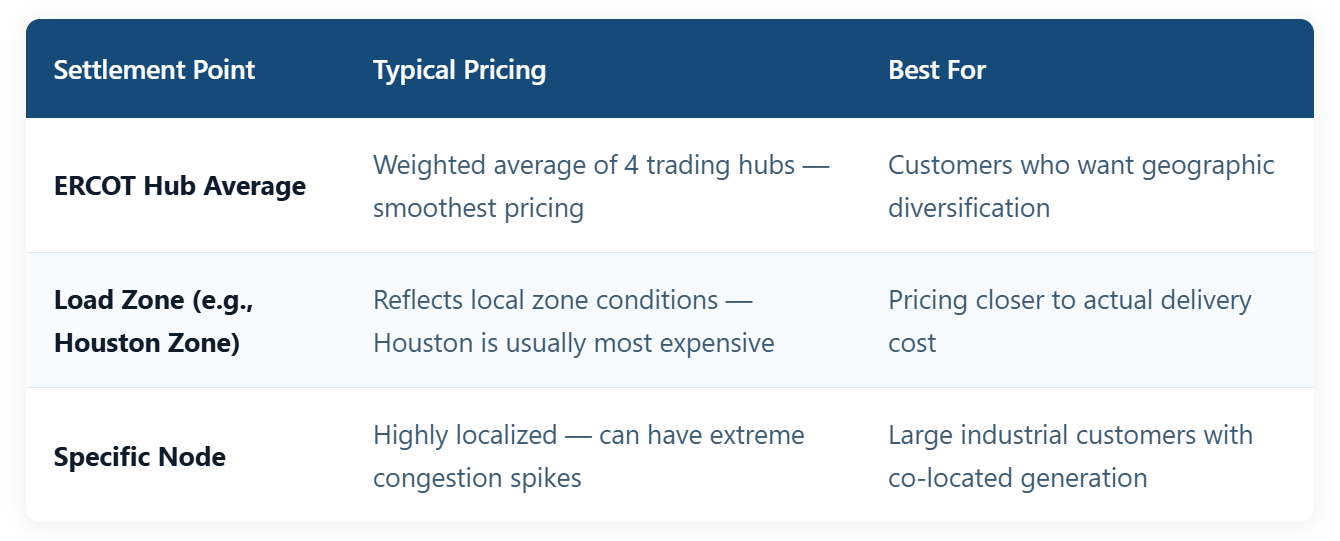
For most commercial customers, a hub-average or load zone settlement is preferable to a specific node settlement. Node-level pricing can expose you to localized congestion events that hub and zone prices would smooth out.
What Drives Wholesale Prices
Understanding the drivers of ERCOT wholesale prices helps you anticipate when your index rate bill will be high or low:
- Natural gas prices: Gas plants set the marginal price in ERCOT for most hours of the year. When Houston Ship Channel gas prices rise, electricity prices follow — typically at a ratio of $7-$10/MWh increase per $1/MMBtu gas increase.
- Weather and temperature: Texas demand is heavily driven by cooling load in summer and heating load in winter. Extreme heat (100°F+ for multiple days) or extreme cold (below freezing with high winds) creates demand spikes that can move prices from normal levels to cap-level prices ($5,000/MWh) within hours.
- Wind and solar generation: Texas has over 40,000 MW of installed wind capacity and over 20,000 MW of solar. When renewables are producing at high levels, prices can drop to zero or even go negative. When wind "droughts" coincide with hot weather, prices spike dramatically.
- Reserve margins: When ERCOT's reserve margin (surplus generation capacity) drops below certain thresholds, an automatic "scarcity adder" called the Operating Reserve Demand Curve (ORDC) kicks in, adding hundreds or thousands of dollars per MWh to the wholesale price.
- Transmission congestion: When local transmission is constrained, prices at the constrained location rise sharply while prices elsewhere may remain normal. This is why settlement point matters for index contracts.
Seasonal Price Patterns
ERCOT wholesale prices follow predictable seasonal patterns that shape the economics of index rate plans:
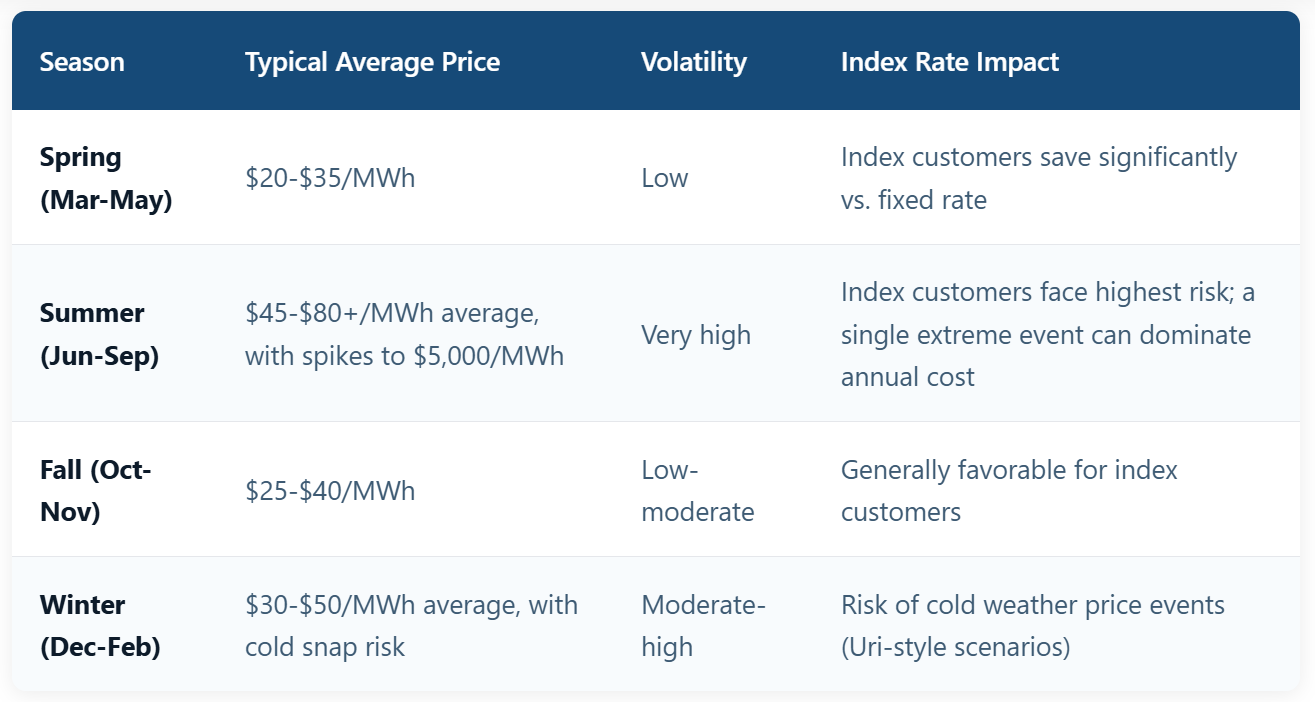
For a business on an index rate plan, spring and fall represent the best case — months of below-average wholesale prices that flow directly to your bill. Summer represents the highest risk — while many summer months are moderate, a single extreme heat event can produce a bill that dwarfs your annual savings from all other months combined.
The Post-Uri Regulatory Landscape
Any honest discussion of variable and index rate plans in Texas has to address Winter Storm Uri and what it changed about the market.
What Happened During Winter Storm Uri
In February 2021, a massive winter storm caused simultaneous surges in electricity demand (heating load) and failures in electricity supply (frozen generators, natural gas supply disruptions). ERCOT wholesale prices sustained the system-wide offer cap of $9,000/MWh for more than four days. This was not a brief spike — it was sustained cap-level pricing for approximately 100 hours.
Businesses and residents on pure wholesale-passthrough plans received bills that were catastrophic. A small business that normally paid $2,000 per month for electricity might receive a bill exceeding $50,000 for a single week. Residential customers on Griddy, the most prominent pure-wholesale residential product, received bills in the tens of thousands of dollars. Griddy filed for bankruptcy shortly thereafter.
The regulatory response was significant and reshaped the commercial index rate market:
PUCT Action on Wholesale-Indexed Products
In 2021, the Public Utility Commission of Texas (PUCT) banned wholesale-indexed products for residential and small commercial customers. The specific threshold is generally set at 50 kW of peak demand — customers below this threshold cannot be offered pure wholesale-indexed products. The rationale was clear: residential and small commercial customers lack the sophistication and financial resilience to absorb extreme wholesale price events.
Larger commercial customers (above 50 kW peak demand) can still access wholesale-indexed products. However, the products offered today generally include protective features that were not standard before Uri:
- Price caps: Many current index products include a maximum rate ceiling (e.g., $500/MWh or $1,000/MWh). If the wholesale index exceeds the cap, you pay the cap price rather than the full wholesale price. The cap protects you from catastrophic events while preserving most index exposure.
- Circuit breakers: Some contracts include provisions that automatically convert the customer to a fixed rate if wholesale prices exceed certain thresholds for sustained periods. This is a form of automatic hedging against extreme events.
- Mandatory hedge percentages: Some REPs require that a minimum percentage of your expected consumption be hedged at a fixed price, effectively creating a block-and-index structure by contract design.
The Evolution of Commercial Index Products
Post-Uri, the commercial index market has evolved significantly. Pure wholesale pass-through is rarer and typically only offered to large industrial customers with sophisticated risk management capabilities. More common today are structured products that offer index exposure with managed risk:
- Index with cap: Pure index pricing except during extreme events. You get most of the index upside with catastrophic-event protection.
- Block-and-index: A fixed block covers your baseload consumption; only the variable portion floats at index.
- Index with hedge layer: The REP automatically hedges a percentage of your exposure and charges the hedge cost as part of the adder. You get index pricing with embedded insurance.
These structures recognize that pure wholesale exposure is appropriate for only a narrow slice of customers, and that most commercial buyers want some form of market participation without the catastrophic downside.
Block and Index: The Sophisticated Middle Ground
Block and index — sometimes called "block + index" or "hybrid" — has become the most common commercial structure for businesses that want some exposure to wholesale market upside without full index risk. Here is how it works:
Structure
You and your REP agree on a "block" of electricity — typically a percentage of your expected consumption — that will be priced at a fixed rate. Any consumption above or below the block is settled at the wholesale market index.
Example: Your facility uses approximately 100,000 kWh per month. You agree to an 80% block at $55/MWh ($0.055/kWh) fixed, with the remaining 20% settled at the ERCOT day-ahead Houston zone index plus a $4/MWh adder.
- If you use exactly 100,000 kWh: 80,000 kWh × $55/MWh + 20,000 kWh × (index + $4)/MWh
- If you use more (say 110,000 kWh): the extra 10,000 kWh is also settled at index + $4
- If you use less (say 90,000 kWh): you are "short" on your block. The REP sells your unused block back at the prevailing market price, which can be a gain or loss depending on market conditions
Why Block-and-Index Appeals to Commercial Buyers
- Budget predictability on the majority of load: 70-80% of your consumption is priced at a known fixed rate, giving you budget certainty on most of your electricity cost.
- Market participation on the remainder: The index portion captures favorable market conditions when they occur. During mild spring months, the 20-30% at index often pays less than the fixed block rate.
- Reduced risk premium: Because the REP is not fully hedging your entire consumption, their risk premium is lower than on a pure fixed rate contract. Your blended cost is typically 3-8% lower than a 100% fixed rate contract.
- Tail risk management: During extreme events, only the variable portion gets hit. Your 80% fixed block is protected. A Uri-style event might increase your total bill by 30-50% rather than 200-500%.
Block Sizing Strategy
Choosing the right block percentage depends on your risk tolerance, market view, and usage characteristics:
- 90-100% block: Essentially a fixed rate contract with minimal index exposure. Choose this if you want maximum predictability but appreciate a small risk premium reduction.
- 70-80% block: The most common structure. Meaningful market participation with substantial budget predictability. Appropriate for most commercial customers considering a hybrid.
- 50-60% block: Aggressive market participation. Only appropriate for businesses with strong financial resilience and operational flexibility to manage through occasional high-cost months.
- 25-40% block: Essentially an index product with a hedge floor. For sophisticated commercial customers who want mostly market-based pricing with some downside protection.
The block should generally match your "must-run" or baseload consumption — the usage you cannot curtail even during high-price events. The index portion represents your more flexible consumption.
The Real Risks of Index Rate Plans
Index rate plans come with real risks that need to be clearly understood before signing. These are not theoretical — they have produced business-destroying bills for unprepared commercial customers.
Price Spike Risk
The most visible risk is that wholesale prices spike dramatically during extreme events. During the February 2021 winter storm, prices sustained the $9,000/MWh cap for multiple days. Even at today's $5,000/MWh cap, a multi-day sustained spike produces bills that are multiples of a normal monthly cost.
Price spike risk is not limited to extreme events. Normal summer heat waves routinely produce 4-8 hours per day of prices above $500/MWh during the hottest weeks. If your business consumes the most during afternoon peak hours, your weighted-average index rate can be 2-3 times the market-wide average.
Basis Risk
Basis risk is the risk that the wholesale index your contract references diverges from the actual cost of serving your load. For example, a contract indexed to the ERCOT North Hub price might not capture localized congestion in the Houston zone where your business is located. During a congestion event, Houston prices can be $50-$100/MWh higher than the North Hub — which means you pay a higher effective cost than the index suggests.
Basis risk is manageable by choosing the right settlement point — ideally the load zone closest to your physical location. But it is a real consideration when evaluating contract terms.
Shape Risk
Shape risk (also called profile risk) is the risk that your consumption pattern does not align with the flat index used to settle your contract. Most index contracts settle against hour-by-hour market prices, so a business that consumes heavily during peak afternoon hours faces a different effective cost than a business that consumes primarily at night, even if both are on the same nominal contract.
Index rate customers with peaky consumption profiles should expect their effective rate to be meaningfully higher than the market-average index — often 10-25% higher, depending on how aligned their usage is with peak pricing periods.
Operational Risk
Index rate plans require more active management than fixed rate plans. You need to monitor wholesale market conditions, understand your bill each month, and ideally have the operational flexibility to reduce consumption during high-price periods. Businesses without the staffing or systems to manage this effectively often do not capture the savings that make index rates attractive in theory.
Cash Flow Risk
Even if an index rate plan delivers lower average cost over a multi-year period, the month-to-month variance can strain cash flow. A business that budgets $15,000/month for electricity will have problems if a summer bill comes in at $35,000, even if spring bills were only $10,000. The annual average might look fine, but the monthly variability can create real financial stress.
When Index Rates Make Sense
Index rate plans are not for every business. They make the most sense when specific conditions are present:
Financial Resilience
You need the financial capacity to absorb an occasional bill that is 2-4 times your normal monthly cost without operational disruption. A $50,000 emergency electricity bill should be painful but not existential for your business. If a single high bill would create serious financial problems, you are not a candidate for index exposure.
Operational Flexibility
The best index rate outcomes go to businesses that can actively manage consumption during high-price periods. If you can shift production overnight, pre-cool buildings before afternoon peaks, reduce discretionary loads when prices are high, or curtail non-essential operations during scarcity events, you capture additional value that offsets spike risk.
Manufacturing facilities with batch-processing schedules, data centers with flexible workloads, and cold storage facilities with thermal mass are natural candidates. Businesses with fixed operational schedules — restaurants, retail stores, hotels — have less flexibility and correspondingly less upside on index products.
High Load Factor
Businesses with high load factor (flat, predictable consumption) benefit most from index pricing because their usage aligns closely with the average market price rather than peaking during expensive hours. A 24/7 manufacturing operation with 90% load factor captures more of the index upside than a business that concentrates consumption in afternoon peak hours.
Large Consumption Volume
Index rate savings scale with consumption. A business using 1,000,000 kWh per month benefits dramatically more from a 0.5 cent/kWh index-vs-fixed savings than a business using 50,000 kWh per month — $5,000 vs. $250 per month. At larger volumes, actively managing index exposure becomes economically justified in a way it is not at smaller volumes.
Market View
If you believe the current forward electricity market is pricing in excessive risk — inflating fixed rates beyond what wholesale prices will actually average over the contract period — an index rate allows you to bet on that view. This is a speculative position and should be approached with caution, but it is a legitimate reason sophisticated commercial customers choose index structures in certain market environments.
When Index Rates Do Not Make Sense
The corresponding list of situations where index rates are a poor fit is equally important:
- Tight margins: If your business cannot absorb a monthly electricity bill 2-4 times your normal cost without operational disruption, do not sign an index contract.
- Summer-peaked usage: Businesses that consume the most during summer months are exposed to the highest index risk. Restaurants, hotels, and other cooling-heavy businesses typically face higher effective index rates than their consumption volume would suggest.
- Inflexible operations: If you cannot reduce consumption during price spikes, you are a price-taker with no defensive options.
- Lack of monitoring capacity: If nobody at your company will monitor wholesale markets and your monthly bills, the active management that justifies index exposure will not happen.
- Lender or lease requirements: Some commercial leases and financing arrangements require fixed electricity costs. Check your obligations before signing an index contract.
How Index Rate Contracts Are Priced and Negotiated
The economics of an index rate contract boil down to the REP's adder — the fixed margin they charge above the wholesale index. Everything else in the contract is either the index itself (which the market sets) or regulatory pass-throughs (which nobody controls).
Components of the Adder
The REP's adder on an index contract typically covers:
- Operating costs: Customer service, billing, regulatory compliance, account management. Roughly $1-$2/MWh.
- Ancillary services: ERCOT charges for reserve and grid stability. If passed through as part of the adder, roughly $2-$4/MWh.
- Credit risk: The REP's cost of credit support for wholesale market purchases. Varies based on REP financial position and customer credit.
- REP margin: Profit. Competitive market adders are typically $1-$3/MWh.
- Shape and line loss adjustments: Accounts for the difference between bulk wholesale pricing and delivery to your specific location. Roughly $1-$3/MWh.
Total adders in the competitive Texas commercial market typically range from $3/MWh for large industrial accounts to $8-$12/MWh for mid-size commercial customers. An adder above this range is expensive; an adder below this range may indicate the REP is not fully covering their actual costs (which could create issues down the road).
What You Should Negotiate
When evaluating index rate contracts, the negotiable elements include:
- The adder itself: Multiple competitive quotes compress adders. Target the low end of the market range for your size class.
- Settlement point: Hub vs. zone vs. node. Choose the settlement that matches your physical location and minimizes basis risk.
- Settlement market: Day-ahead vs. real-time. Day-ahead settlement has lower volatility and is appropriate for most commercial customers.
- Block size (if hybrid): Negotiate the fixed-to-index ratio that matches your risk tolerance.
- Price caps or circuit breakers: If available, negotiate a cap on your effective rate during extreme events. This adds a small cost to the adder but provides meaningful protection.
- Contract term: Shorter contracts give you flexibility to adjust if your situation changes.
- Termination flexibility: Index contracts often have lower ETFs than fixed contracts because the REP has less sunk cost in hedging. Negotiate this.
Reading the Index Rate Contract: Critical Fine Print
Index rate contracts contain technical language that can significantly affect your costs. Pay careful attention to:
Settlement Formula
Exactly how is your rate calculated? Which market (DAM or RTM)? Which settlement point? How are ancillary services charged? A well-drafted contract specifies the exact formula so you can verify each month's bill against ERCOT published data.
Index Definition
What specific ERCOT index is used? Is it the hourly price, the daily average, the monthly average? How are off-peak vs. peak hours handled? Different indexes produce materially different results.
Change of Law / Regulatory Changes
Index contracts often contain broad provisions allowing the REP to pass through any regulatory or market changes. Limit these provisions to specific, enumerated changes rather than leaving the REP with broad discretion.
Demand and Capacity Charges
Are demand charges included, passed through, or fixed? How are 4CP (Four Coincident Peak) capacity charges calculated? These can be material costs that vary significantly based on contract structure.
Minimum Billing / Floor Rates
Some index contracts include minimum billing provisions that prevent your effective rate from dropping below a specified floor, even when wholesale prices are negative. This is the REP protecting themselves, and it reduces your upside.
Termination Provisions
How can the contract be terminated? What are the ETFs? Can the REP terminate if your usage changes significantly or if market conditions move adversely? These provisions are often overlooked but matter enormously if circumstances change.
Managing Active Exposure: Best Practices for Index Customers
Signing an index rate contract is the start, not the end. Businesses that succeed on index products actively manage their exposure. Here are the tactics that work:
Monitor Wholesale Markets
ERCOT publishes real-time and day-ahead prices on their public dashboard. Many commercial customers have someone check these prices daily or weekly. More sophisticated users subscribe to alerts for scarcity conditions, high day-ahead clearing prices, or tight reserve margins. The goal is to know when conditions are deteriorating so you can adjust operations.
Shift Flexible Loads
Wholesale prices follow daily patterns — typically highest between 2-7 PM in summer and 6-9 AM in winter. If your operations have any flexibility, shifting energy-intensive activities to off-peak hours reduces your effective rate. Run batch processes overnight. Pre-cool buildings in the morning when prices are low. Schedule maintenance that requires high power draw during low-price periods.
Implement Demand Response
Some ERCOT programs pay commercial customers to reduce consumption during scarcity events. If your business has the flexibility to curtail during emergencies, these programs can offset some of the cost of occasional high-price events. Many REPs can enroll their commercial customers in demand response programs as a value-added service.
Use Energy Management Systems
Modern building management systems can automate load reduction based on external price signals. When wholesale prices exceed a threshold, HVAC setpoints can adjust, non-essential equipment can shut down, and backup generation (if available) can come online. This automation is particularly valuable for businesses with complex operations where manual response is impractical.
Reconcile Bills Against ERCOT Data
One advantage of index contracts is that every billing component can be verified against public ERCOT data. Most commercial index customers (or their brokers) reconcile their monthly bills against the published settlement data to catch errors. REPs occasionally mis-bill, and catching errors can recover thousands of dollars.
Industry-Specific Considerations
The fit of index rate plans varies significantly by industry:
Manufacturing and Industrial
Industrial facilities with 24/7 operations, high load factors, and consumption in the MW range are natural candidates for index exposure. They have the volume where adder compression matters, the load profile where index upside is maximized, and often the operational flexibility to curtail or shift during price events. Many industrial operations use block-and-index with 70-80% blocks to balance predictability with market participation.
Data Centers
Data centers present a split picture. Their extremely flat, 24/7 load is ideal for index pricing. But their inability to curtail operations means they have limited defensive options during price spikes. Most commercial data centers use block-and-index with heavy blocks (80-90%) or fixed-with-index-component hybrid structures.
Cold Storage and Warehousing
Cold storage facilities have meaningful thermal mass — they can pre-cool during low-price hours and coast through peak periods. This operational flexibility makes them strong candidates for index or block-and-index structures where they can actively manage around high-price events.
Hospitality and Food Service
Hotels and restaurants are typically poor candidates for significant index exposure. Their operations are inflexible (you cannot close the restaurant during afternoon price spikes), their consumption correlates with peak cooling demand (summer afternoons), and their margins are tight. Most hospitality and food service operations should stick with fixed rate plans.
Retail and Multi-Family
Retail and multi-family residential properties generally favor fixed rates for predictability, though larger portfolios may consider block-and-index structures where they can aggregate volume and diversify across locations.
Index Rate vs. Fixed Rate: A Decision Framework
Here is a practical framework for deciding between fixed and index rate structures:
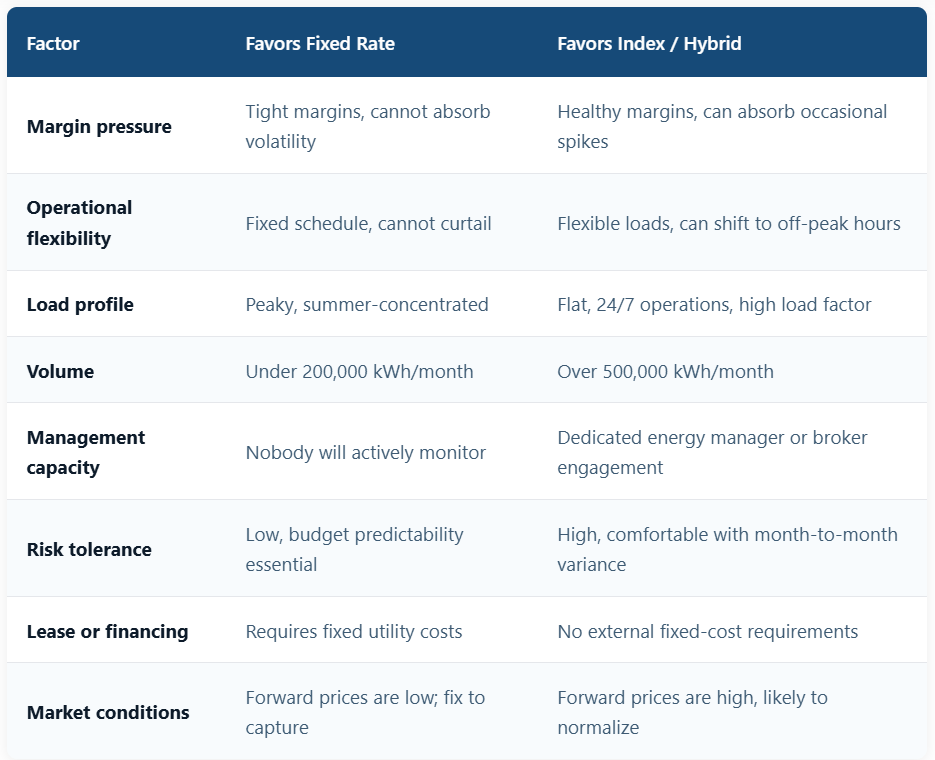
For most commercial customers, the answer is a combination. Pure fixed rate is right for most small and mid-size businesses with predictable operations. Pure index is appropriate for a narrow slice of sophisticated large commercial and industrial buyers. Block-and-index hybrids represent the middle ground that captures meaningful market participation with manageable risk — and this is where many sophisticated mid-market buyers land.
See our complete comparison of fixed vs. variable rate electricity plans for more guidance.
Current Market Context: 2026
As of April 2026, the Texas variable and index rate market reflects the following conditions:
- Index market participation: Approximately 15-20% of Texas commercial accounts (above the 50 kW threshold) use some form of index-based pricing, including block-and-index hybrids. Pure wholesale pass-through represents a small minority of this group.
- Typical adders: $3-$8/MWh for accounts above 500 kW, $6-$12/MWh for smaller commercial accounts eligible for index pricing.
- Wholesale market conditions: ERCOT day-ahead prices averaged $32-$45/MWh across the first quarter of 2026. Summer 2026 forward prices are trading around $55-$65/MWh average, reflecting moderate summer risk expectations.
- Regulatory environment: The 50 kW threshold for wholesale-indexed products remains in effect. Post-Uri protections (price caps, circuit breakers) are now standard features of most commercial index products.
- Most common hybrid structure: 75-80% fixed block with 20-25% index settlement at Houston or North zone day-ahead prices. Blended cost is typically 5-8% lower than 100% fixed rate in calm markets.
Frequently Asked Questions
What is an index rate electricity plan?
An index rate electricity plan ties your energy charge directly to a published wholesale market index — typically ERCOT day-ahead or real-time prices — plus a fixed adder from your REP. Unlike a fixed rate plan where your rate is constant, an index rate fluctuates every hour, day, or month based on wholesale market conditions. When market prices are low, you pay less. When they spike, you pay more.
What is the difference between variable rate and index rate electricity?
The terms are often used interchangeably, but there is a technical distinction. A variable rate can change at the REP's discretion based on a methodology they disclose in the contract — and the methodology may not be fully transparent. An index rate is explicitly tied to a published wholesale market index (like ERCOT's day-ahead settlement price), so the pricing formula is transparent and verifiable. For commercial customers, true index rates are generally preferable because they eliminate the risk of opaque REP-driven rate adjustments.
Can businesses still get index rate electricity plans in Texas after Winter Storm Uri?
Yes, but the landscape changed significantly after Winter Storm Uri in February 2021. The Public Utility Commission of Texas banned wholesale-indexed products for residential and small commercial customers (generally those under 50 kW demand). However, larger commercial and industrial customers can still access index rate and block-and-index products through REPs and energy brokers. The available structures have also evolved, with most commercial index products now including some form of price cap, circuit breaker, or hedging component to prevent catastrophic billing events.
Is an index rate electricity plan cheaper than fixed rate?
Index rates are typically cheaper than fixed rates over long periods in calm market conditions because you avoid the risk premium that REPs embed in fixed rate contracts. However, a single extreme weather event or summer heat wave can produce an index rate bill that is 3-10 times your normal cost, erasing years of savings. Index rates are not cheaper — they are differently distributed. You pay less in most months and potentially dramatically more in a few months.
What is a block and index electricity plan?
A block and index plan is a hybrid structure where a fixed "block" of your expected consumption is priced at a locked rate, while any consumption above or below the block is settled at the wholesale market index. For example, if you use 100,000 kWh per month, you might block 80,000 kWh at a fixed rate and have the remaining 20,000 kWh float at the wholesale index. This provides budget predictability on your baseload consumption while giving you exposure to favorable market prices on the variable portion.
What happened to businesses on variable rate plans during Winter Storm Uri?
During Winter Storm Uri in February 2021, ERCOT wholesale electricity prices sustained the $9,000 per MWh cap for multiple days. Businesses on unhedged variable or index rate plans faced bills that were 50-200 times their normal monthly cost. Some small businesses on pure wholesale-passthrough products like Griddy received bills in the tens of thousands of dollars for a single week. Griddy subsequently filed for bankruptcy, and regulatory changes were implemented to protect smaller customers from similar events.
When does a variable or index rate make sense for a business?
A variable or index rate can make sense for businesses that have the financial resilience to absorb occasional price spikes, the operational flexibility to reduce consumption during high-price periods, and the sophistication to actively monitor wholesale markets. High load factor industrial operations, data centers with flexible workloads, and businesses with significant off-peak consumption are the best candidates. Small businesses with tight margins and inflexible operations are generally poor candidates for pure index exposure.
How does ERCOT wholesale pricing actually flow to my business's bill?
On an index rate plan, your energy charge is calculated by taking the ERCOT wholesale settlement price for each hour you consumed electricity, adding your REP's fixed adder (margin and costs), and multiplying by your hourly consumption. Your bill shows the weighted average rate across the billing period plus separate line items for TDU delivery, ancillary services, and other pass-through costs. The specific settlement point used — real-time vs. day-ahead, hub vs. zone vs. node — significantly affects your exposure and should be clearly specified in your contract.