
How Texas Businesses Can Hedge Against Electricity Price Volatility

Electricity is one of the largest controllable operating expenses for most Texas commercial businesses — and one of the most volatile. In the ERCOT market, wholesale prices can swing from $20/MWh to $5,000/MWh within hours. Even businesses on retail contracts are exposed to this volatility at renewal time, when market conditions determine the rates available to them. For CFOs, facility managers, and procurement teams, the question is not whether to manage electricity price risk — it is how.

This guide covers the full spectrum of hedging strategies available to Texas commercial electricity buyers, from the simplest (fixed-rate contracts) to the most sophisticated (layered procurement with financial instruments). Each strategy has trade-offs between cost certainty, potential savings, complexity, and risk. Understanding these trade-offs is essential for making procurement decisions that align with your business's financial objectives and risk tolerance..


Why Electricity Price Volatility Matters to Your Business

Before diving into hedging strategies, it is worth quantifying why electricity price risk deserves active management — particularly in Texas.


ERCOT Is Uniquely Volatile

The Texas electricity market is more volatile than most U.S. power markets for several structural reasons:

  • Energy-only market design. Unlike PJM, MISO, or ISO-NE, ERCOT does not have a capacity market that pays generators to be available. Revenue comes entirely from energy and ancillary service sales, which means prices must spike high enough during scarcity events to keep generators economically viable year-round. This design intentionally produces higher price spikes than capacity-market regions.
  • Extreme weather exposure. Texas faces both extreme summer heat (driving cooling demand to record levels) and periodic severe winter events. The February 2021 Winter Storm Uri saw prices sustained at the then-$9,000/MWh cap for multiple days. Summer heat waves regularly push real-time prices above $1,000/MWh for extended afternoon periods.
  • High renewable penetration. Texas leads the nation in wind generation and has rapidly growing solar capacity. While this provides abundant low-cost energy during favorable conditions (driving prices to zero or negative), it also creates "wind drought" and "solar duck curve" dynamics that amplify price spikes when renewable output drops during high-demand periods.
  • Grid isolation. The ERCOT grid is largely disconnected from the rest of the U.S. power grid. When supply is tight, Texas cannot easily import electricity from neighboring regions, which concentrates price pressure within the state.


The Business Impact Is Real

For a Texas business consuming 100,000 kWh per month, the difference between a $0.07/kWh rate and a $0.12/kWh rate is $5,000 per month — $60,000 per year. For a multi-location operation consuming 500,000+ kWh per month, rate differences translate to hundreds of thousands of dollars annually. These are not hypothetical swings — they represent the actual range of rates available to commercial customers depending on when they contract and what structure they choose.

More critically, businesses on expired contracts or poorly timed renewals can face even larger cost increases. The goal of hedging is not to eliminate all price risk (that is neither possible nor desirable) but to manage it so that electricity costs are predictable enough to protect margins and support financial planning.


The Hedging Spectrum: From Simple to Sophisticated

Commercial electricity hedging exists on a spectrum. At one end is a simple fixed-rate retail contract — the most basic hedge. At the other end are multi-layered procurement strategies using financial instruments, blended structures, and active portfolio management. Most Texas businesses should be somewhere on this spectrum; very few should be at either extreme.


Strategy 1: Full Fixed-Rate Contract

The simplest hedge available. You sign a fixed-rate contract with a REP for 12-36 months. Your per-kWh energy rate is locked for the entire term, regardless of what happens in the wholesale market.
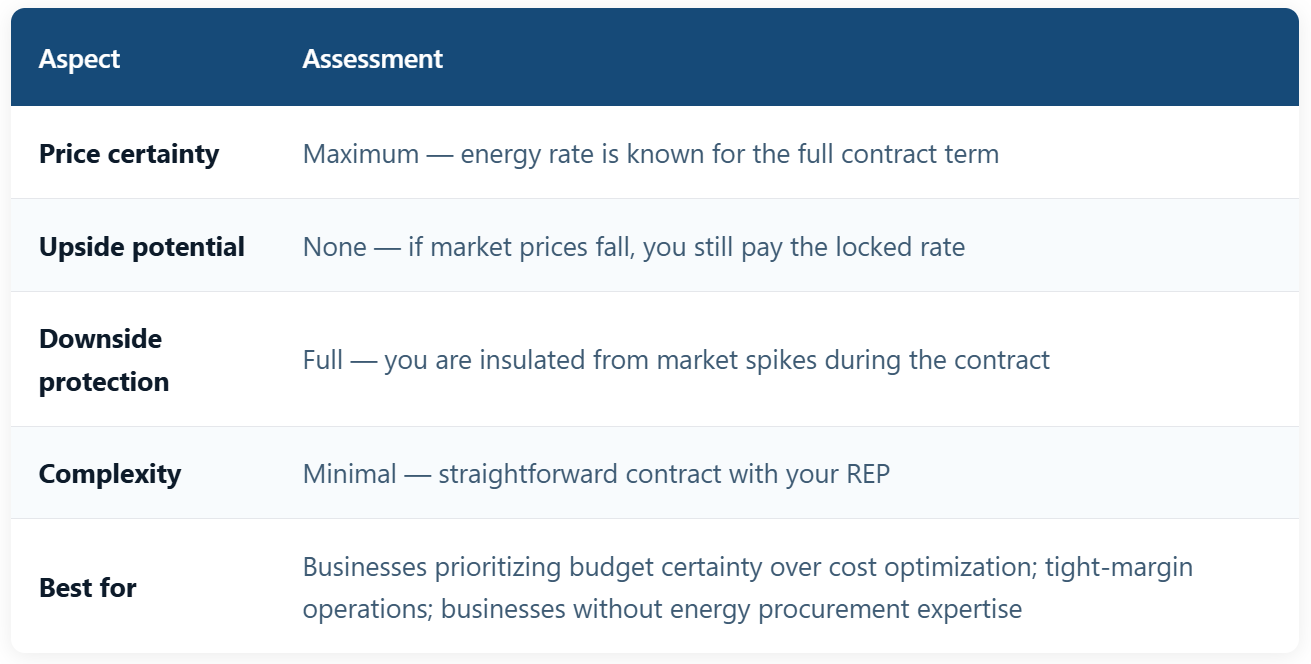

The hidden cost of fixed rates: The REP builds a risk premium into fixed rates to compensate for the market risk they absorb on your behalf. This premium is typically 5-15% above the expected average wholesale cost over the contract period. You are paying for certainty, and that payment is embedded in your rate — you just cannot see it as a separate line item.

Timing risk remains: A fixed rate locks you in at the market conditions prevailing when you sign. If you sign during a high-price period (summer, or during a supply crunch), your locked rate reflects those elevated conditions for the full contract term. This is why contract timing matters enormously for fixed-rate buyers. The best fixed-rate hedges are those signed when forward market prices are low — typically October through February.


Strategy 2: Block-and-Index (Hybrid) Structure

A block-and-index contract hedges a portion of your load at a fixed rate while leaving the remainder exposed to market pricing. Common splits are 50/50, 60/40, or 70/30 (fixed/variable). The fixed "block" provides a baseline of budget certainty. The variable "index" portion captures market upside when prices are low.

This structure is the most popular hedging approach for sophisticated mid-market commercial buyers. It offers a disciplined middle ground between the full certainty of a fixed rate and the full exposure of an index rate.


How Block-and-Index Works in Practice

Suppose your business averages 200,000 kWh per month. Under a 60/40 block-and-index contract:

  • 120,000 kWh (60%) is priced at a fixed block rate of $0.068/kWh = $8,160/month (predictable)
  • 80,000 kWh (40%) is priced at the ERCOT index price plus a fixed adder — might be $0.045/kWh in spring or $0.095/kWh in summer (variable)

In a mild spring month when index prices are low ($0.045/kWh), your blended rate is: (120,000 × $0.068 + 80,000 × $0.045) / 200,000 = $0.0588/kWh — below what a fully fixed rate would cost.

In a hot August when index prices spike ($0.095/kWh), your blended rate is: (120,000 × $0.068 + 80,000 × $0.095) / 200,000 = $0.0788/kWh — higher than the mild month but significantly lower than fully index pricing.

The fixed block acts as a shock absorber, dampening the impact of market spikes on your total cost while still allowing you to benefit from low-price periods.

Block-and-index structures smooth out the extremes — you pay less than fully fixed during low-price periods and less than fully variable during spikes.

Strategy 3: Layered or Stacked Procurement

Layered procurement is the most sophisticated hedging approach available through the retail market. Instead of committing 100% of your anticipated load in a single transaction at a single point in time, you build your hedge incrementally — purchasing fixed blocks at different times over a 12-24 month window leading up to your delivery period.


How Layering Works

Suppose you need to hedge 1,000,000 kWh of monthly consumption starting January 2027. Under a layered approach:

  • January 2026: Fix 25% of load (250,000 kWh) at the prevailing forward rate — say $0.072/kWh
  • April 2026: Fix another 25% at $0.065/kWh (market has dipped with mild spring conditions)
  • July 2026: Fix another 25% at $0.078/kWh (summer prices are elevated)
  • October 2026: Fix the final 25% at $0.063/kWh (fall prices are low)

Your blended fixed rate: ($0.072 + $0.065 + $0.078 + $0.063) / 4 = $0.0695/kWh

By spreading purchases across four transactions over 12 months, you avoid the risk of locking in 100% at a single point that might be a local market peak. You will never get the absolute best price (because you are not 100% at the bottom), but you will also never get the absolute worst price. The layered approach is, essentially, dollar-cost averaging applied to electricity procurement.


When Layering Makes Sense


  • Large consumers (500,000+ kWh/month) where the absolute dollar impact of rate timing is significant
  • Multi-year procurement horizons where you are hedging 24-36 months ahead
  • Businesses with active energy management teams or broker relationships that can execute multiple transactions over time
  • Organizations where budget certainty is important but overpaying for a fully fixed rate is unacceptable


Strategy 4: Financial Hedges (Swaps and Options)

Large commercial consumers — particularly industrial facilitiesdata centers, and multi-location enterprises consuming millions of kWh per month — can access financial hedging instruments directly, separate from their retail electricity contract.


Fixed-for-Floating Swaps

An electricity swap is a financial contract where you agree to pay a fixed price per MWh and receive the floating (market) price in return. The swap settles financially — no physical electricity is involved. If the market price exceeds your fixed swap price, you receive a payment. If it falls below, you make a payment. The net effect is that your electricity cost is locked at the swap price regardless of market movements.

Swaps are typically executed through commodity brokers or directly with counterparties (banks, trading firms, large REPs with trading desks). They settle against ERCOT hub prices (Houston Hub, North Hub, South Hub, West Hub) and are available for forward periods ranging from one month to several years.

Key advantage: Swaps separate your physical supply decision from your hedging decision. You can buy physical electricity from whatever REP offers the best service and terms, while managing price risk through a separate financial instrument.

Key risk: Basis risk between the swap settlement point (ERCOT hub price) and your actual load cost. Your retail rate includes TDU charges, REP adders, and other costs that the swap does not hedge. The swap hedges the wholesale energy component only.


Call Options (Price Caps)

A call option gives you the right — but not the obligation — to buy electricity at a specified "strike" price. If market prices exceed the strike, you exercise the option and pay the strike price. If market prices are below the strike, you let the option expire and buy at the lower market price. Options provide downside protection (a price ceiling) while preserving upside potential.

The trade-off is the option premium — the upfront cost you pay for this protection. Option premiums in ERCOT can be substantial because of the market's high volatility. A summer cap option for July-August might cost $5-15/MWh in premium, which adds to your total electricity cost regardless of whether the option is exercised.

Options are most valuable for businesses that want to stay on index pricing to capture low-price periods but need a ceiling to protect against extreme events. Think of it as insurance: you pay the premium for protection, and hope you never need it.


Collar Structures

A collar combines buying a call option (ceiling) and selling a put option (floor). The put option you sell generates premium income that offsets the cost of the call option you buy. The result is a cost-neutral or low-cost price band — you will pay no more than the ceiling and no less than the floor.

Example: You buy a $60/MWh call and sell a $30/MWh put. If market prices rise above $60, your cost is capped at $60. If prices fall below $30, you still pay $30. Between $30 and $60, you pay the market price. The premium from selling the put approximately offsets the cost of buying the call.

Collars are popular with CFOs because they provide budget certainty (a known range) at minimal upfront cost, while still allowing participation in moderate market movements.

Financial hedges like swaps, options, and collars separate your physical electricity supply from your price risk management — giving you more control over both.

Building an Energy Risk Management Framework

Beyond choosing a hedging strategy, businesses with material electricity spend should establish a structured approach to energy risk management. This does not require a dedicated energy team — but it does require intentionality:


1. Define Your Risk Tolerance

What is the maximum percentage increase in electricity cost that your business can absorb in a given year without materially impacting operations, margins, or financial commitments? This number determines how much exposure you can leave unhedged. A business that cannot tolerate more than a 10% year-over-year increase needs to hedge aggressively. A business that can absorb a 30% swing has more flexibility to leave exposure open and capture potential market upside..


2. Set Hedging Targets by Timeframe

A common framework used by sophisticated energy buyers:

  • Current year: 80-100% hedged (budget is set, minimize variance)
  • Year 2: 50-75% hedged (partial certainty, room to add at better prices)
  • Year 3: 25-50% hedged (strategic layer, opportunistic buying)

This graduated approach ensures near-term budget certainty while maintaining flexibility to respond to market conditions for future periods. As time passes, you fill in the hedge for each forward year, ideally buying when market conditions are favorable.


3. Monitor Market Conditions

Effective hedging requires market awareness. You do not need to watch real-time ERCOT prices daily, but you should be tracking — or have your broker tracking — several key indicators:

  • Natural gas forward prices — the primary driver of wholesale electricity prices in Texas
  • ERCOT forward power prices — available through your broker or energy trading platforms
  • Seasonal reserve margin forecasts — published by ERCOT in the CDR report, indicating how tight supply/demand conditions are expected to be
  • Weather forecasts — particularly for the upcoming summer (cooling demand drives prices) and winter (heating demand, freeze risk)

When forward prices dip below your target level (defined by your risk framework), that is the signal to execute a hedge transaction. When prices are elevated, hold if your hedge ratio is already within your target band. This is disciplined, rule-based procurement — not market speculation.


4. Review and Adjust Annually

At least once per year (and ideally quarterly for large consumers), review your hedge position against your risk targets. Has your load changed? Have market conditions shifted your outlook? Does your business strategy still support the same risk tolerance? Adjust accordingly.


Common Hedging Mistakes

In working with hundreds of Texas commercial electricity buyers, we see the same mistakes repeatedly:

  • Confusing hedging with speculation. A hedge reduces uncertainty. Leaving your entire load unhedged because you believe prices will drop is not "saving money" — it is speculating on electricity prices, which is not your core business. Conversely, locking in 100% at a rate you hope is the bottom is also speculation. A disciplined hedge accepts that you will not get the best possible price, in exchange for knowing your costs within an acceptable range.
  • Treating electricity procurement as a one-time event. Many businesses sign a contract, forget about it for two years, then scramble to renew at the last minute. This approach means you buy at whatever market conditions happen to prevail when your contract expires — which is random, not strategic. Energy procurement should be an ongoing process, not a biennial transaction.
  • Ignoring demand charges. Most hedging strategies focus on the per-kWh energy rate. But demand charges can represent 30-70% of a commercial bill, and they are not hedged by a fixed energy rate. A comprehensive risk management approach addresses both energy costs and demand costs. Our guide on load factor covers the demand side.
  • Overcomplicating the approach for your size. Financial hedges (swaps, options, collars) involve transaction costs, credit requirements, and complexity that only make sense for large consumers. A business consuming 50,000 kWh per month does not need financial derivatives — a well-timed fixed or block-and-index contract provides sufficient risk management at a fraction of the complexity.
  • Not accounting for TDU delivery charges. Your energy hedge (whether fixed contract, swap, or option) covers the supply side of your bill. TDU delivery charges — which include their own demand charges and per-kWh fees — are regulated and outside your hedge. Make sure your budget projections include both hedged energy costs and unhedged delivery costs for an accurate total cost forecast.


The Role of a Broker in Hedging

An experienced energy broker serves as your market intelligence, execution, and advisory partner across all these strategies. Specifically, a broker can:

  • Monitor ERCOT forward prices and alert you when market conditions favor execution
  • Solicit competitive bids from multiple REPs for any structure (fixed, block-and-index, layered)
  • Structure block-and-index ratios based on your specific load profile and risk tolerance
  • Coordinate layered procurement across multiple transaction windows
  • For large consumers, connect you with financial hedge counterparties and advise on swap/option structures
  • Maintain a procurement calendar so you never land on a holdover rate

The broker's cost is typically embedded in the REP's rate (the broker is compensated by the supplier, not by you), so there is no direct cost to the buyer for retail hedging advisory. For financial hedges, there may be separate advisory fees depending on complexity.


The Bottom Line

Electricity price volatility in the ERCOT market is not going away — if anything, it is intensifying as renewable penetration grows, extreme weather events become more frequent, and demand from data centers and electrification increases. Businesses that manage this volatility intentionally — through disciplined hedging, appropriate structure selection, and strategic timing — will consistently outperform those that buy reactively or leave costs to chance.


Start with your risk tolerance. Define how much cost variability your business can absorb. Then select the hedging strategy that provides appropriate certainty at acceptable cost. And execute it as an ongoing process — not a one-time transaction every two years.

The difference between strategic energy procurement and passive procurement is not luck — it is process. The process does not need to be complex. But it does need to exist.



May 9, 2026
Timing is everything in the Texas electricity market. The difference between renewing your commercial electricity contract at the right time versus the wrong time can amount to tens of thousands of dollars over the life of your agreement. Yet most Texas businesses treat contract renewal as an afterthought — something they deal with reactively rather than strategically. In a deregulated market like ERCOT , you have the power to choose your supplier and negotiate your terms. But that power is only useful if you exercise it at the right moment. This guide explains exactly when and how to approach your commercial electricity contract renewal for maximum savings. Know Your Contract End Date This sounds obvious, but it is the number one reason businesses overpay for electricity. The majority of commercial customers we work with do not know when their current electricity contract expires until it is too late. When your contract ends without a new agreement in place, one of two things typically happens — and neither one is good for your business: Auto-renewal at a holdover rate. Some contracts include a provision that automatically rolls you into a new term, but at a significantly higher rate. These holdover rates are rarely competitive — they are set by the REP without any negotiation, and they can be 20-50% above market rates. Month-to-month variable pricing. Without a contract in place, you default to a month-to-month variable rate that fluctuates with the wholesale market. This means you have no price protection during peak demand periods when electricity is most expensive. Both scenarios cost you money, and both are entirely avoidable. The fix starts with one simple action: find out when your current contract ends and put that date on your calendar — with a reminder set 120 days in advance. The 3-4 Month Rule The single most important tactical advice for contract renewal is this: start shopping 90 to 120 days before your contract expires. There are several reasons this timeline works: Forward pricing availability. Electricity suppliers offer forward pricing — rates locked in today for a future start date. These forward offers are typically available 30 to 120 days out. Starting early gives you access to the widest range of forward pricing options. Competitive leverage. When suppliers know you are shopping well in advance, they compete harder for your business. A business that calls one week before contract expiration has limited leverage because the supplier knows you are under time pressure. Time to compare. Evaluating bids from multiple suppliers takes time. You need to compare not just the headline rate, but the contract terms, fee structures, pass-through mechanisms, and early termination provisions. Our guide to fixed vs. variable rate electricity breaks down each option. Rushing this process leads to overlooked details that cost money. Market flexibility. Starting early means you can watch the market for favorable pricing windows. If rates are trending down, you can wait a few weeks. If rates are about to spike (heading into summer, for example), you can lock in before the increase. The Renewal Timeline 120 days out: Begin gathering your usage data and contacting brokers or suppliers. 90 days out: Review competitive bids and compare options. 60 days out: Finalize your selection and execute the contract. 30 days out: Confirm the switch is on track with your new supplier and ERCOT. Market Timing: When Are Texas Electricity Prices Lowest? The Texas electricity market follows predictable seasonal patterns driven largely by weather and natural gas prices. Understanding these patterns can help you time your contract renewal for the best possible rates. Generally, the best time to lock in a commercial electricity rate in Texas is between October and March. During this window, electricity demand is lower (mild weather means less HVAC load), natural gas prices — which drive the marginal cost of electricity generation in Texas — tend to be more stable, and suppliers are more willing to offer competitive forward pricing to secure volume for the coming year. Conversely, the most expensive time to sign a contract is during the summer months, particularly June through August. Wholesale prices are elevated due to peak cooling demand, and suppliers price their forward contracts to reflect the risk of extreme heat events. If you lock in a 24- or 36-month contract at summer peak pricing, you are paying an inflated rate for the entire term — not just the summer months. Timing your contract renewal to coincide with lower market periods can save your business thousands over the contract term. That said, the "best time" is a general guideline, not a guarantee. Unusual weather patterns, natural gas supply disruptions, changes in generation capacity, and regulatory developments can all move prices outside of their typical seasonal ranges. This is why ongoing market monitoring matters — and why working with a professional who tracks these factors daily is so valuable. Watch the Calendar, Not Just the Market Beyond general seasonal trends, several specific calendar events and market factors can significantly impact electricity pricing in Texas: ERCOT capacity and reserve margin reports. ERCOT publishes seasonal assessments of expected generation capacity versus demand. When reserve margins are tight — meaning the grid has less cushion between available supply and expected demand — forward prices tend to rise as suppliers price in the higher risk of scarcity events. Hurricane season (June-November). Gulf Coast hurricanes can disrupt natural gas production and electricity transmission infrastructure. The mere forecast of an active hurricane season can push forward prices higher as suppliers hedge against potential supply disruptions. Planned generation outages. Power plants schedule maintenance during lower-demand periods, but the timing and duration of these outages affects available supply. When multiple plants are offline simultaneously, prices can rise even during typically mild periods. Natural gas market movements. Since natural gas is the primary fuel for Texas electricity generation, significant movements in the Henry Hub benchmark directly impact electricity forward pricing. A cold winter that drives up natural gas demand nationally can raise Texas electricity prices even before summer arrives. Tracking all of these factors yourself is a full-time job. This is one of the core services an energy broker provides — continuous market monitoring so that when it is time to renew your contract, you are making a decision based on current conditions, not last month's assumptions. Early Termination: When It Makes Sense to Break a Contract Sometimes the smartest move is not waiting for your contract to expire — it is getting out early. If market rates have dropped significantly below your current locked-in rate, paying the early termination fee (ETF) and signing a new contract at lower rates can actually save you money over the remaining term. Here is how to evaluate whether early termination makes financial sense: Calculate your remaining cost. Multiply your current rate by your expected consumption for the remaining months of your contract. This is what you will pay if you stay. Get current market pricing. Obtain competitive bids for a new contract covering the same remaining period. Calculate what you would pay at the new rate. Add the ETF. Your current contract specifies the early termination fee — typically a per-kWh charge multiplied by your remaining expected usage, or a flat dollar amount. Compare totals. If the new contract cost plus the ETF is less than the cost of staying on your current contract, early termination is the financially rational choice. This calculation is straightforward in principle, but the details matter. Some ETFs are structured to decrease over the contract term, making termination more attractive as you approach expiration. Others have minimum charges that make early termination prohibitively expensive regardless of market conditions. An experienced broker can run these numbers for you and tell you exactly where the break-even point is. How a Broker Helps With Contract Renewals The businesses that consistently get the best electricity rates in Texas are not the ones who happen to get lucky with timing. They are the ones who have a professional managing their energy procurement on an ongoing basis. Here is what a good energy broker does for you around contract renewal: Tracks your contract dates. You do not need to set calendar reminders or dig through filing cabinets to find your contract terms. Your broker knows exactly when every agreement expires and starts the renewal process at the optimal time. Monitors market conditions. Instead of checking electricity prices yourself (which most business owners have neither the time nor the expertise to do meaningfully), your broker is watching daily market movements and will advise you on when conditions favor locking in a rate. Solicits competitive bids. Rather than calling individual REPs one at a time, your broker sends your usage profile to 25+ suppliers simultaneously, generating a competitive bidding environment that drives prices down. Reviews contract terms. The headline rate is only part of the picture. Your broker reviews the full contract for unfavorable terms, hidden fees, pass-through mechanisms, and termination provisions that could cost you down the line. Provides continuity. Your broker retains your historical usage data, knows your business's energy profile, and understands your preferences from previous renewal cycles. This institutional knowledge means each renewal is more efficient and better tailored than the last. All of this comes at no cost to your business — the broker is compensated by the supplier, not by you.  A broker manages the entire renewal process — from market monitoring to contract execution — so you can focus on running your business. Take Control of Your Next Renewal Your commercial electricity contract is one of the largest controllable expenses in your business. Treating renewal as a strategic decision rather than an administrative task can save you thousands of dollars every year. The key principles are simple: know your contract end date, start shopping 90-120 days early, time your renewal to avoid peak market periods, and work with a professional who monitors the market and negotiates on your behalf. For more ways to reduce costs, see our guide to lowering commercial electricity bills . Businesses that follow this approach consistently pay less for electricity than those who let contracts auto-renew or wait until the last minute. If you do not know when your current contract expires, that is the first thing to fix.
May 9, 2026
Texas is one of the few states in the country with a fully deregulated electricity market. That means businesses operating within the ERCOT grid have the freedom to choose their Retail Electric Provider (REP) — a significant advantage that can translate into real savings on one of your largest operating expenses. But freedom of choice comes with complexity. There are more than 25 licensed REPs serving the Texas commercial market, each offering dozens of plans with varying rate structures, contract terms, and fee schedules. Navigating this landscape on your own is time-consuming, and without market expertise, it is easy to leave money on the table. That is why a growing number of Texas businesses — from single-location restaurants to multi-site industrial operations — work with energy brokers rather than going directly to providers. What Does an Energy Broker Actually Do? An energy broker acts as an intermediary between your business and multiple electricity suppliers. Rather than you contacting each REP individually to request pricing, your broker handles the entire process on your behalf. Here is how it typically works: The broker collects your usage data. This includes your historical consumption (usually 12 months of usage history), your current rate and contract terms, your meter information, and your TDU service area. The broker solicits competitive bids. Using your usage profile, the broker requests pricing from multiple suppliers simultaneously. This creates a competitive bidding environment — suppliers know they are competing against each other, which drives prices down. The broker presents your options. You receive a side-by-side comparison of bids from multiple suppliers, including the rate per kWh , contract length, rate structure ( fixed, variable, or hybrid ), and any fees or special terms. You choose. The broker explains the options and makes recommendations based on your business's needs, but the final decision is always yours. The broker manages the transition. Once you select a supplier, the broker handles the contract execution and coordinates with ERCOT for the switch. There is no interruption to your service.  The most important thing to understand is that the broker is paid by the supplier, not by you. REPs build a small commission into their pricing to compensate the broker. This is the same commission structure that exists whether you go through a broker or not — when you go direct, the REP's internal sales team earns that same margin. Using a broker does not add cost to your bill.
May 9, 2026
When most Texas business owners think about their electricity cost, they think about one number: the per-kWh rate. That number represents energy charges — what you pay for the volume of electricity you consume. But hidden beneath that headline rate is a second, often larger cost component that most businesses never scrutinize: capacity charges. These charges — which show up as demand charges , transmission demand fees, and various per-kW assessments — pay for the grid's ability to deliver power at your peak consumption level, regardless of how much total energy you use. Understanding the fundamental difference between energy and capacity costs is essential for commercial electricity buyers who want to move beyond surface-level rate shopping and actually control their total cost of power. This guide breaks down both cost components in depth, explains how each is calculated, identifies the trends driving each component, and provides strategies for managing both. The Fundamental Distinction Every dollar on your commercial electricity bill ultimately pays for one of two things: Energy Costs: Paying for Fuel and Generation Energy charges pay for the actual electricity you consume — the kilowatt-hours (kWh) that powered your lights, HVAC, equipment, and operations during the billing period. These charges reflect the cost of generating electricity: the fuel (natural gas, wind, solar), the operating costs of power plants, and the wholesale market dynamics that determine the price at which generators sell their output. Energy charges are volumetric — they scale directly with how much electricity you use. If you use twice as much electricity, your energy charges roughly double. If you shut down for a week, your energy charges drop proportionally. On your bill, energy charges typically appear as: Energy charge (per kWh) from your REP TDU energy delivery charge (per kWh) from your TDU Fuel factor or energy pass-through charges (on some contract structures)  Capacity Costs: Paying for Infrastructure and Readiness Capacity charges pay for the grid's ability to deliver power at the rate you need it — measured in kilowatts (kW) of peak demand. These charges cover the physical infrastructure (transformers, substations, distribution lines, transmission towers) that must be sized to handle your maximum draw, the generation capacity that must be available to serve peak system-wide demand, and the ancillary services that keep the grid stable. Capacity charges are demand-based — they scale with the highest rate at which you consume electricity at any point during the billing period, not the total volume you consume. Two businesses can use the exact same total kWh in a month but pay dramatically different capacity charges if one draws power steadily and the other draws it in sharp peaks. On your bill, capacity charges typically appear as: TDU demand charge (per kW) — often the largest single capacity-related line item Transmission demand charge (per kW) — covering high-voltage transmission infrastructure REP demand charge (per kW) — some contracts include a supply-side demand component Coincident peak (4CP) charges — based on your usage during ERCOT system peak periods Capacity obligation or ancillary service charges — covering grid reliability requirements
May 9, 2026
Restaurants are among the most energy-intensive businesses in the commercial sector. Between commercial kitchen equipment running at full capacity during service, walk-in coolers and freezers operating around the clock, HVAC systems battling Texas heat, and hood ventilation fans that never stop, electricity is often the second-largest operating expense for Texas restaurants — right behind labor. Our restaurants and food industry page covers how we help operators across the state. The good news is that operating in ERCOT's deregulated electricity market means you have options. Unlike states where a single utility dictates your rate, Texas restaurant operators can choose their commercial electricity supplier, negotiate their contract terms, and implement operational strategies that directly reduce what they pay. This guide covers the practical, high-impact actions you can take to bring those electricity costs down. Why Restaurant Electricity Bills Are So High Before you can fix the problem, it helps to understand why restaurants use so much electricity compared to other commercial businesses of similar size. The answer comes down to two factors: total consumption and peak demand. On the consumption side, restaurants operate energy-hungry equipment for extended hours: Walk-in coolers and freezers run 24 hours a day, 7 days a week. These are the baseline of your electricity usage, drawing power even when the restaurant is closed. Commercial ovens, fryers, and grills consume massive amounts of electricity during prep and service. A single commercial convection oven can draw 10-15 kW. HVAC systems work overtime in Texas, especially from May through September. The kitchen generates significant heat, so your cooling system is not just fighting outdoor temperatures — it is fighting the heat your own equipment produces. Hood ventilation systems are required by code to run whenever cooking equipment is in operation, and they pull conditioned air out of the building, forcing the HVAC to work harder. Lighting, POS systems, dishwashers, and ice machines round out a substantial base load that runs through every shift. All of this equipment running simultaneously is what drives the second factor — peak demand — which is where the real cost pain point lies for most restaurants.
Show More