
What Happens When Your Commercial Electricity Contract Expires

Your commercial electricity contract has an end date. If you do not sign a new contract before that date, your power does not get shut off — but what does happen can cost your business thousands of dollars per month. In the Texas deregulated market, an expired contract means you are automatically moved to a month-to-month holdover rate that is almost always dramatically more expensive than any contracted rate you could get.

This guide explains exactly what happens when your commercial electricity contract expires, how much it can cost you, and how to make sure it never happens to your business.


The Holdover Rate: What It Is and Why It Exists

When your electricity contract reaches its end date and you have not signed a new agreement, your REP does not disconnect your service. Instead, they move you to what is commonly called a holdover rate, month-to-month rate, or default variable rate. Different REPs use different terminology, but the result is the same: you continue receiving electricity, but at a significantly higher price.

Holdover rates exist because the REP is now supplying your electricity without the certainty of a long-term contract. They are buying power on the wholesale market to serve you but have no commitment from you on volume or duration. That uncertainty carries a risk premium — and the REP passes that risk premium directly to you in the form of a higher rate.

How much higher? Holdover rates are typically 50% to 200% above what you would pay on a negotiated contract. For a business consuming 50,000 kWh per month, the difference between a contracted rate of $0.07/kWh and a holdover rate of $0.14/kWh is $3,500 per month — $42,000 per year in unnecessary cost.


Why So Many Businesses End Up on Holdover Rates

Despite the massive cost difference, a surprising number of Texas businesses are on holdover rates right now without realizing it. The most common reasons:

  • The contract expired and nobody noticed. For many businesses, the electricity contract was signed two or three years ago by someone who may no longer be with the company. The end date came and went, and no one in the organization tracked it.
  • The renewal notice was missed or ignored. Most REPs send a renewal notice 30-60 days before contract expiration. These notices often look like routine correspondence and get lost in a pile of mail or buried in an inbox. By the time someone notices, the contract has already expired.
  • The business assumed auto-renewal at the same rate. Some business owners assume their contract will automatically renew at the same terms. In reality, most commercial contracts either expire to a holdover rate or auto-renew at a new (often higher) rate that the REP has selected — not the rate you originally negotiated.
  • Procrastination. Shopping for a new electricity contract is not exciting work. It gets pushed to next week, next month — and suddenly you are three months past expiration, paying holdover rates the entire time.


Many businesses discover they are on holdover rates only when they see an unexpectedly high bill — by then, they have already been overpaying for weeks or months.

What Auto-Renewal Actually Means

Some commercial electricity contracts include an auto-renewal clause. This sounds convenient, but it is not always in your favor. Auto-renewal does not mean your current rate continues. It typically means one of two things:

  • Renewal at a new rate set by the REP. The REP selects a rate for your renewal term, which may be higher or lower than your original rate depending on current market conditions. You are locked into this new rate for the renewal period (often 12 months) unless you opted out before the renewal window closed.
  • Renewal at a variable or month-to-month rate. Some auto-renewal clauses simply move you to a variable rate rather than a fixed term. This is essentially the same as a holdover rate.

The key problem with auto-renewal is that it removes your leverage. In a competitive market where you have the power to shop 100+ REPs, auto-renewal lets one REP set your rate without competitive pressure. You lose the primary benefit of deregulation.


The Real Cost: A Concrete Example

Consider a mid-size Texas business — a restaurant group with three locations, each consuming around 40,000 kWh per month (120,000 kWh total). Their contracted rate was $0.068/kWh for energy supply. When the contract expired unnoticed, they were moved to a holdover rate of $0.139/kWh.
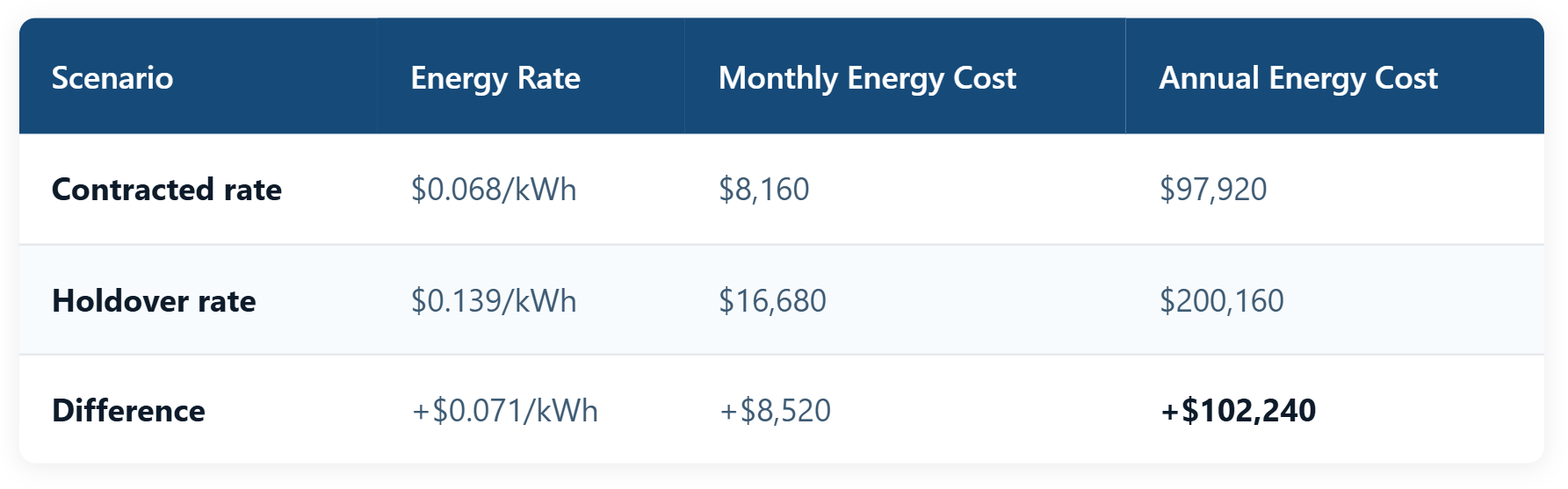

That is over $100,000 per year in avoidable cost — just for the energy supply portion, not including demand charges and TDU delivery fees. And this scenario is not unusual. We see businesses overpaying by similar amounts every month because their contract expired without their knowledge.


How to Prevent This

The solution is straightforward. It requires a small amount of organization but can save your business tens of thousands of dollars:

1. Know Your Contract End Date

Find your current electricity contract and identify the end date. If you cannot find the contract, call your REP and ask. They are required to tell you. Put this date in your calendar with reminders at 4 months, 3 months, and 2 months before expiration.

2. Start Shopping 3-4 Months Early

Three to four months before your contract ends is the ideal time to start getting quotes. This gives you enough time to compare options, negotiate terms, and sign a new contract without rushing — and without any gap between your current contract and the new one. Our guide on when to renew your contract covers timing strategy in detail.

3. Compare Multiple Suppliers

Do not just call your current REP and ask for a renewal rate. In a competitive market, the best rate comes from competition. Get quotes from multiple REPs — or work with a broker who can get quotes from 25+ suppliers simultaneously.

4. Read the Auto-Renewal Clause

Before you sign any new contract, understand the auto-renewal terms. Specifically:

  • Does the contract auto-renew? At what rate?
  • What is the opt-out window? (How far in advance must you notify the REP that you do not want to auto-renew?)
  • Is there an early termination fee if you switch before the contract ends?


Setting calendar reminders 3-4 months before your contract end date is the simplest way to avoid expensive holdover rates.

Already on a Holdover Rate? Here Is What to Do

If you suspect you are currently on a holdover rate — or if your bill has increased significantly without explanation — here is the action plan:

  • Check your bill immediately. Look for language like "month-to-month," "holdover," "variable default," or "out of contract" on your statement. Compare your current per-kWh energy rate to what you were paying six months ago. Our guide on reading your bill can help.
  • Get quotes today. Holdover rates have no lock-in period — you can sign a new contract and switch immediately. There is no penalty for leaving a holdover rate because there is no contract to break.
  • Expect a 2-4 week transition. Once you sign a new contract (with your current REP or a new one), the switch typically takes one billing cycle to process. You will pay the holdover rate for that transition period, which is why acting quickly matters.


The Bottom Line

An expired electricity contract is one of the most expensive mistakes a Texas business can make — and one of the easiest to prevent. Understanding fixed vs. variable rate structures helps you choose the right replacement contract. For more cost reduction strategies, see our guide to lowering commercial electricity bills. The entire problem is solved by knowing your contract end date and starting the renewal process 3-4 months early.

If you are unsure of your contract status, check today. The cost of being on a holdover rate for even a single month can exceed what most businesses spend on marketing for an entire quarter.



May 9, 2026
Timing is everything in the Texas electricity market. The difference between renewing your commercial electricity contract at the right time versus the wrong time can amount to tens of thousands of dollars over the life of your agreement. Yet most Texas businesses treat contract renewal as an afterthought — something they deal with reactively rather than strategically. In a deregulated market like ERCOT , you have the power to choose your supplier and negotiate your terms. But that power is only useful if you exercise it at the right moment. This guide explains exactly when and how to approach your commercial electricity contract renewal for maximum savings. Know Your Contract End Date This sounds obvious, but it is the number one reason businesses overpay for electricity. The majority of commercial customers we work with do not know when their current electricity contract expires until it is too late. When your contract ends without a new agreement in place, one of two things typically happens — and neither one is good for your business: Auto-renewal at a holdover rate. Some contracts include a provision that automatically rolls you into a new term, but at a significantly higher rate. These holdover rates are rarely competitive — they are set by the REP without any negotiation, and they can be 20-50% above market rates. Month-to-month variable pricing. Without a contract in place, you default to a month-to-month variable rate that fluctuates with the wholesale market. This means you have no price protection during peak demand periods when electricity is most expensive. Both scenarios cost you money, and both are entirely avoidable. The fix starts with one simple action: find out when your current contract ends and put that date on your calendar — with a reminder set 120 days in advance. The 3-4 Month Rule The single most important tactical advice for contract renewal is this: start shopping 90 to 120 days before your contract expires. There are several reasons this timeline works: Forward pricing availability. Electricity suppliers offer forward pricing — rates locked in today for a future start date. These forward offers are typically available 30 to 120 days out. Starting early gives you access to the widest range of forward pricing options. Competitive leverage. When suppliers know you are shopping well in advance, they compete harder for your business. A business that calls one week before contract expiration has limited leverage because the supplier knows you are under time pressure. Time to compare. Evaluating bids from multiple suppliers takes time. You need to compare not just the headline rate, but the contract terms, fee structures, pass-through mechanisms, and early termination provisions. Our guide to fixed vs. variable rate electricity breaks down each option. Rushing this process leads to overlooked details that cost money. Market flexibility. Starting early means you can watch the market for favorable pricing windows. If rates are trending down, you can wait a few weeks. If rates are about to spike (heading into summer, for example), you can lock in before the increase. The Renewal Timeline 120 days out: Begin gathering your usage data and contacting brokers or suppliers. 90 days out: Review competitive bids and compare options. 60 days out: Finalize your selection and execute the contract. 30 days out: Confirm the switch is on track with your new supplier and ERCOT. Market Timing: When Are Texas Electricity Prices Lowest? The Texas electricity market follows predictable seasonal patterns driven largely by weather and natural gas prices. Understanding these patterns can help you time your contract renewal for the best possible rates. Generally, the best time to lock in a commercial electricity rate in Texas is between October and March. During this window, electricity demand is lower (mild weather means less HVAC load), natural gas prices — which drive the marginal cost of electricity generation in Texas — tend to be more stable, and suppliers are more willing to offer competitive forward pricing to secure volume for the coming year. Conversely, the most expensive time to sign a contract is during the summer months, particularly June through August. Wholesale prices are elevated due to peak cooling demand, and suppliers price their forward contracts to reflect the risk of extreme heat events. If you lock in a 24- or 36-month contract at summer peak pricing, you are paying an inflated rate for the entire term — not just the summer months. Timing your contract renewal to coincide with lower market periods can save your business thousands over the contract term. That said, the "best time" is a general guideline, not a guarantee. Unusual weather patterns, natural gas supply disruptions, changes in generation capacity, and regulatory developments can all move prices outside of their typical seasonal ranges. This is why ongoing market monitoring matters — and why working with a professional who tracks these factors daily is so valuable. Watch the Calendar, Not Just the Market Beyond general seasonal trends, several specific calendar events and market factors can significantly impact electricity pricing in Texas: ERCOT capacity and reserve margin reports. ERCOT publishes seasonal assessments of expected generation capacity versus demand. When reserve margins are tight — meaning the grid has less cushion between available supply and expected demand — forward prices tend to rise as suppliers price in the higher risk of scarcity events. Hurricane season (June-November). Gulf Coast hurricanes can disrupt natural gas production and electricity transmission infrastructure. The mere forecast of an active hurricane season can push forward prices higher as suppliers hedge against potential supply disruptions. Planned generation outages. Power plants schedule maintenance during lower-demand periods, but the timing and duration of these outages affects available supply. When multiple plants are offline simultaneously, prices can rise even during typically mild periods. Natural gas market movements. Since natural gas is the primary fuel for Texas electricity generation, significant movements in the Henry Hub benchmark directly impact electricity forward pricing. A cold winter that drives up natural gas demand nationally can raise Texas electricity prices even before summer arrives. Tracking all of these factors yourself is a full-time job. This is one of the core services an energy broker provides — continuous market monitoring so that when it is time to renew your contract, you are making a decision based on current conditions, not last month's assumptions. Early Termination: When It Makes Sense to Break a Contract Sometimes the smartest move is not waiting for your contract to expire — it is getting out early. If market rates have dropped significantly below your current locked-in rate, paying the early termination fee (ETF) and signing a new contract at lower rates can actually save you money over the remaining term. Here is how to evaluate whether early termination makes financial sense: Calculate your remaining cost. Multiply your current rate by your expected consumption for the remaining months of your contract. This is what you will pay if you stay. Get current market pricing. Obtain competitive bids for a new contract covering the same remaining period. Calculate what you would pay at the new rate. Add the ETF. Your current contract specifies the early termination fee — typically a per-kWh charge multiplied by your remaining expected usage, or a flat dollar amount. Compare totals. If the new contract cost plus the ETF is less than the cost of staying on your current contract, early termination is the financially rational choice. This calculation is straightforward in principle, but the details matter. Some ETFs are structured to decrease over the contract term, making termination more attractive as you approach expiration. Others have minimum charges that make early termination prohibitively expensive regardless of market conditions. An experienced broker can run these numbers for you and tell you exactly where the break-even point is. How a Broker Helps With Contract Renewals The businesses that consistently get the best electricity rates in Texas are not the ones who happen to get lucky with timing. They are the ones who have a professional managing their energy procurement on an ongoing basis. Here is what a good energy broker does for you around contract renewal: Tracks your contract dates. You do not need to set calendar reminders or dig through filing cabinets to find your contract terms. Your broker knows exactly when every agreement expires and starts the renewal process at the optimal time. Monitors market conditions. Instead of checking electricity prices yourself (which most business owners have neither the time nor the expertise to do meaningfully), your broker is watching daily market movements and will advise you on when conditions favor locking in a rate. Solicits competitive bids. Rather than calling individual REPs one at a time, your broker sends your usage profile to 25+ suppliers simultaneously, generating a competitive bidding environment that drives prices down. Reviews contract terms. The headline rate is only part of the picture. Your broker reviews the full contract for unfavorable terms, hidden fees, pass-through mechanisms, and termination provisions that could cost you down the line. Provides continuity. Your broker retains your historical usage data, knows your business's energy profile, and understands your preferences from previous renewal cycles. This institutional knowledge means each renewal is more efficient and better tailored than the last. All of this comes at no cost to your business — the broker is compensated by the supplier, not by you.  A broker manages the entire renewal process — from market monitoring to contract execution — so you can focus on running your business. Take Control of Your Next Renewal Your commercial electricity contract is one of the largest controllable expenses in your business. Treating renewal as a strategic decision rather than an administrative task can save you thousands of dollars every year. The key principles are simple: know your contract end date, start shopping 90-120 days early, time your renewal to avoid peak market periods, and work with a professional who monitors the market and negotiates on your behalf. For more ways to reduce costs, see our guide to lowering commercial electricity bills . Businesses that follow this approach consistently pay less for electricity than those who let contracts auto-renew or wait until the last minute. If you do not know when your current contract expires, that is the first thing to fix.
May 9, 2026
Texas is one of the few states in the country with a fully deregulated electricity market. That means businesses operating within the ERCOT grid have the freedom to choose their Retail Electric Provider (REP) — a significant advantage that can translate into real savings on one of your largest operating expenses. But freedom of choice comes with complexity. There are more than 25 licensed REPs serving the Texas commercial market, each offering dozens of plans with varying rate structures, contract terms, and fee schedules. Navigating this landscape on your own is time-consuming, and without market expertise, it is easy to leave money on the table. That is why a growing number of Texas businesses — from single-location restaurants to multi-site industrial operations — work with energy brokers rather than going directly to providers. What Does an Energy Broker Actually Do? An energy broker acts as an intermediary between your business and multiple electricity suppliers. Rather than you contacting each REP individually to request pricing, your broker handles the entire process on your behalf. Here is how it typically works: The broker collects your usage data. This includes your historical consumption (usually 12 months of usage history), your current rate and contract terms, your meter information, and your TDU service area. The broker solicits competitive bids. Using your usage profile, the broker requests pricing from multiple suppliers simultaneously. This creates a competitive bidding environment — suppliers know they are competing against each other, which drives prices down. The broker presents your options. You receive a side-by-side comparison of bids from multiple suppliers, including the rate per kWh , contract length, rate structure ( fixed, variable, or hybrid ), and any fees or special terms. You choose. The broker explains the options and makes recommendations based on your business's needs, but the final decision is always yours. The broker manages the transition. Once you select a supplier, the broker handles the contract execution and coordinates with ERCOT for the switch. There is no interruption to your service.  The most important thing to understand is that the broker is paid by the supplier, not by you. REPs build a small commission into their pricing to compensate the broker. This is the same commission structure that exists whether you go through a broker or not — when you go direct, the REP's internal sales team earns that same margin. Using a broker does not add cost to your bill.
May 9, 2026
When most Texas business owners think about their electricity cost, they think about one number: the per-kWh rate. That number represents energy charges — what you pay for the volume of electricity you consume. But hidden beneath that headline rate is a second, often larger cost component that most businesses never scrutinize: capacity charges. These charges — which show up as demand charges , transmission demand fees, and various per-kW assessments — pay for the grid's ability to deliver power at your peak consumption level, regardless of how much total energy you use. Understanding the fundamental difference between energy and capacity costs is essential for commercial electricity buyers who want to move beyond surface-level rate shopping and actually control their total cost of power. This guide breaks down both cost components in depth, explains how each is calculated, identifies the trends driving each component, and provides strategies for managing both. The Fundamental Distinction Every dollar on your commercial electricity bill ultimately pays for one of two things: Energy Costs: Paying for Fuel and Generation Energy charges pay for the actual electricity you consume — the kilowatt-hours (kWh) that powered your lights, HVAC, equipment, and operations during the billing period. These charges reflect the cost of generating electricity: the fuel (natural gas, wind, solar), the operating costs of power plants, and the wholesale market dynamics that determine the price at which generators sell their output. Energy charges are volumetric — they scale directly with how much electricity you use. If you use twice as much electricity, your energy charges roughly double. If you shut down for a week, your energy charges drop proportionally. On your bill, energy charges typically appear as: Energy charge (per kWh) from your REP TDU energy delivery charge (per kWh) from your TDU Fuel factor or energy pass-through charges (on some contract structures)  Capacity Costs: Paying for Infrastructure and Readiness Capacity charges pay for the grid's ability to deliver power at the rate you need it — measured in kilowatts (kW) of peak demand. These charges cover the physical infrastructure (transformers, substations, distribution lines, transmission towers) that must be sized to handle your maximum draw, the generation capacity that must be available to serve peak system-wide demand, and the ancillary services that keep the grid stable. Capacity charges are demand-based — they scale with the highest rate at which you consume electricity at any point during the billing period, not the total volume you consume. Two businesses can use the exact same total kWh in a month but pay dramatically different capacity charges if one draws power steadily and the other draws it in sharp peaks. On your bill, capacity charges typically appear as: TDU demand charge (per kW) — often the largest single capacity-related line item Transmission demand charge (per kW) — covering high-voltage transmission infrastructure REP demand charge (per kW) — some contracts include a supply-side demand component Coincident peak (4CP) charges — based on your usage during ERCOT system peak periods Capacity obligation or ancillary service charges — covering grid reliability requirements
May 9, 2026
Restaurants are among the most energy-intensive businesses in the commercial sector. Between commercial kitchen equipment running at full capacity during service, walk-in coolers and freezers operating around the clock, HVAC systems battling Texas heat, and hood ventilation fans that never stop, electricity is often the second-largest operating expense for Texas restaurants — right behind labor. Our restaurants and food industry page covers how we help operators across the state. The good news is that operating in ERCOT's deregulated electricity market means you have options. Unlike states where a single utility dictates your rate, Texas restaurant operators can choose their commercial electricity supplier, negotiate their contract terms, and implement operational strategies that directly reduce what they pay. This guide covers the practical, high-impact actions you can take to bring those electricity costs down. Why Restaurant Electricity Bills Are So High Before you can fix the problem, it helps to understand why restaurants use so much electricity compared to other commercial businesses of similar size. The answer comes down to two factors: total consumption and peak demand. On the consumption side, restaurants operate energy-hungry equipment for extended hours: Walk-in coolers and freezers run 24 hours a day, 7 days a week. These are the baseline of your electricity usage, drawing power even when the restaurant is closed. Commercial ovens, fryers, and grills consume massive amounts of electricity during prep and service. A single commercial convection oven can draw 10-15 kW. HVAC systems work overtime in Texas, especially from May through September. The kitchen generates significant heat, so your cooling system is not just fighting outdoor temperatures — it is fighting the heat your own equipment produces. Hood ventilation systems are required by code to run whenever cooking equipment is in operation, and they pull conditioned air out of the building, forcing the HVAC to work harder. Lighting, POS systems, dishwashers, and ice machines round out a substantial base load that runs through every shift. All of this equipment running simultaneously is what drives the second factor — peak demand — which is where the real cost pain point lies for most restaurants.
Show More