
Power Purchase Agreements (PPAs) for Texas Commercial Businesses
Power Purchase Agreements have evolved from a niche procurement tool used exclusively by Fortune 500 companies into a viable option for a much broader range of Texas commercial electricity buyers. As renewable energy costs have declined precipitously — solar PPA prices have fallen over 80% since 2010 — and as corporate sustainability commitments have intensified, PPAs are now being evaluated by multi-location restaurant groups, hospital networks, large manufacturing operations, and data center operators across the ERCOT market.
But a PPA is not a standard retail commercial electricity contract. It is a long-term financial instrument with real complexity, significant risks, and consequences that persist for a decade or longer. Entering a PPA without fully understanding its mechanics is one of the most expensive mistakes a commercial energy buyer can make.
This guide provides a thorough examination of how PPAs work in the Texas ERCOT market, the structural differences between physical and virtual PPAs, the financial risks you must evaluate, the accounting implications, and a practical framework for deciding whether a PPA makes sense for your business..
What Is a Power Purchase Agreement?
A Power Purchase Agreement is a long-term contract between an electricity buyer (the "offtaker" — your business) and a power generator (typically a wind farm or solar project developer). Under the agreement, the buyer commits to purchasing the electricity output of a specific generation project at a predetermined price for a fixed term, typically ranging from 10 to 25 years. The generator uses this committed revenue stream — the certainty of a creditworthy buyer purchasing its output for decades — to secure financing for the construction and operation of the project.
This financing mechanism is the core economic rationale behind PPAs. Building a utility-scale wind farm costs $1-2 billion. Building a large solar installation costs hundreds of millions. Lenders and investors will not finance these projects without long-term revenue certainty. The PPA provides that certainty, and in return, the offtaker typically receives electricity at a price below what they would pay on the open market — particularly in later years of the agreement as retail electricity prices rise with inflation, fuel costs, and grid infrastructure investments.
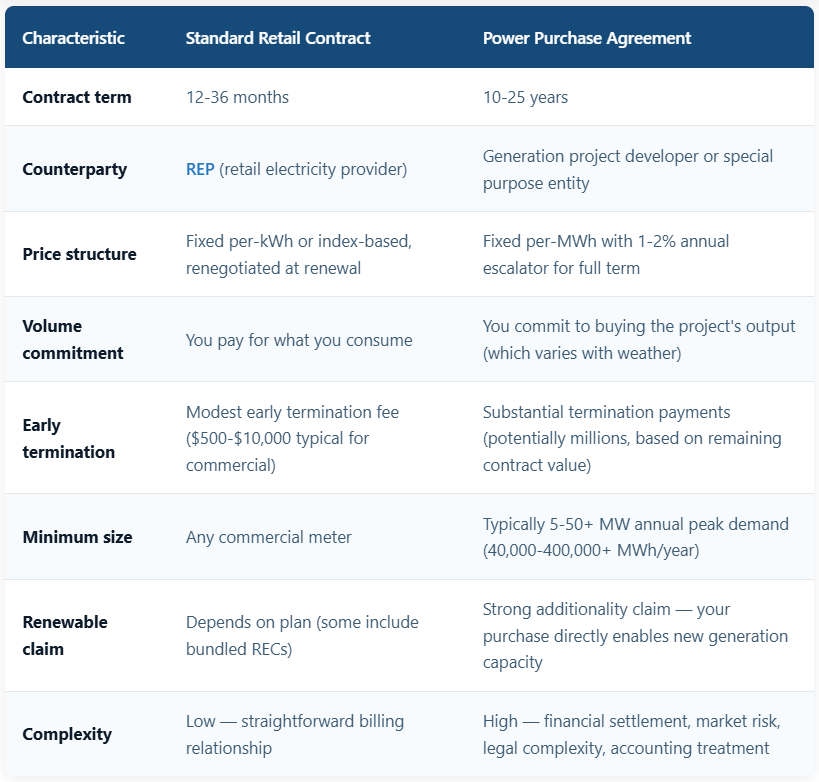
How PPAs Differ From Standard Retail Contracts
Understanding these differences is essential before evaluating any PPA opportunity:
Physical PPAs: Direct Electricity Delivery
In a physical (also called "retail" or "sleeved") PPA, the generator delivers electricity directly to your account through the ERCOT grid. You physically receive and consume the electricity generated by the project. The mechanics are similar to a standard retail electricity contract in how power flows — the key differences are the price structure, term length, counterparty, and the fact that output is variable (dependent on wind or solar conditions).
How Physical PPAs Work Step by Step
- Step 1: Project development. A developer builds a wind farm or solar installation in Texas. They secure land, permits, grid interconnection, and equipment.
- Step 2: PPA negotiation. You negotiate a long-term contract to buy the project's output at a fixed price per MWh (e.g., $35/MWh with a 1.5% annual escalator).
- Step 3: Physical delivery. The project generates electricity and delivers it to your ERCOT load zone. Your meter records delivery, and you are billed at the PPA rate for the delivered volume.
- Step 4: Balancing supply. Because wind and solar output varies, you need a separate arrangement — typically with a REP — to supply electricity during hours when the project is not generating enough to meet your demand (nighttime for solar, calm-wind periods for wind). This is called the "firming" or "balancing" requirement.
- Step 5: Surplus handling. When the project generates more than you consume (windy overnight periods, for example), the excess is sold back into the ERCOT market. The contract specifies how surplus revenue is shared.
Advantages of Physical PPAs
- Simpler accounting. Physical PPAs are typically treated as executory contracts (normal supply agreements) rather than derivatives, which simplifies financial reporting.
- Direct supply relationship. The electricity physically flows to your meter, creating a clear and tangible connection between the PPA and your consumption.
- Reduced basis risk. If the project is located in or near your ERCOT load zone, the price difference between the project's settlement point and your load's settlement point is minimized.
Limitations of Physical PPAs
- Geographic constraint. The project and your load should be in the same ERCOT zone to minimize delivery costs and congestion risk.
- Firming cost. You still need a REP arrangement for hours when the project is not generating. This adds complexity and cost that must be factored into the total economics.
- Volume mismatch. Your consumption pattern does not match the project's generation pattern. A solar PPA produces during daytime hours; your facility may operate 24/7. A wind PPA may produce heavily at night when your restaurant is closed.

Physical PPAs deliver electricity directly to your account, but the intermittent nature of renewable generation means you need a backup supply arrangement for hours when the project is not producing.
Virtual PPAs: The Financial Hedge Structure
A virtual PPA — also called a contract for differences (CFD), synthetic PPA, or financial PPA — is a purely financial arrangement. Unlike a physical PPA, no electricity is delivered to your account under the contract. Instead, the PPA functions as a financial hedge against wholesale electricity prices.
How Virtual PPAs Work Step by Step
- Step 1: Separate physical supply. You continue buying your physical electricity from a REP under a standard retail contract, exactly as you do today.
- Step 2: Financial settlement. The generator sells its output into the ERCOT wholesale market at whatever the market price happens to be. Separately, you and the generator settle the difference between the agreed PPA "strike price" and the actual market price for each settlement period.
- Step 3: Settlement mechanics. When the market price exceeds the strike price, the generator pays you the difference — you profit from the hedge. When the market price falls below the strike price, you pay the generator the difference — the hedge costs you money. The settlement is financial only; no electrons change hands between you and the generator.
- Step 4: REC transfer. The generator transfers Renewable Energy Certificates (RECs) to you, allowing you to claim the renewable attributes of the project's output for sustainability reporting purposes, even though you are not physically receiving the electricity.
A Concrete Virtual PPA Example
Your business enters a 15-year virtual PPA with a West Texas wind farm at a strike price of $32/MWh. Here is how settlement works in different market conditions:
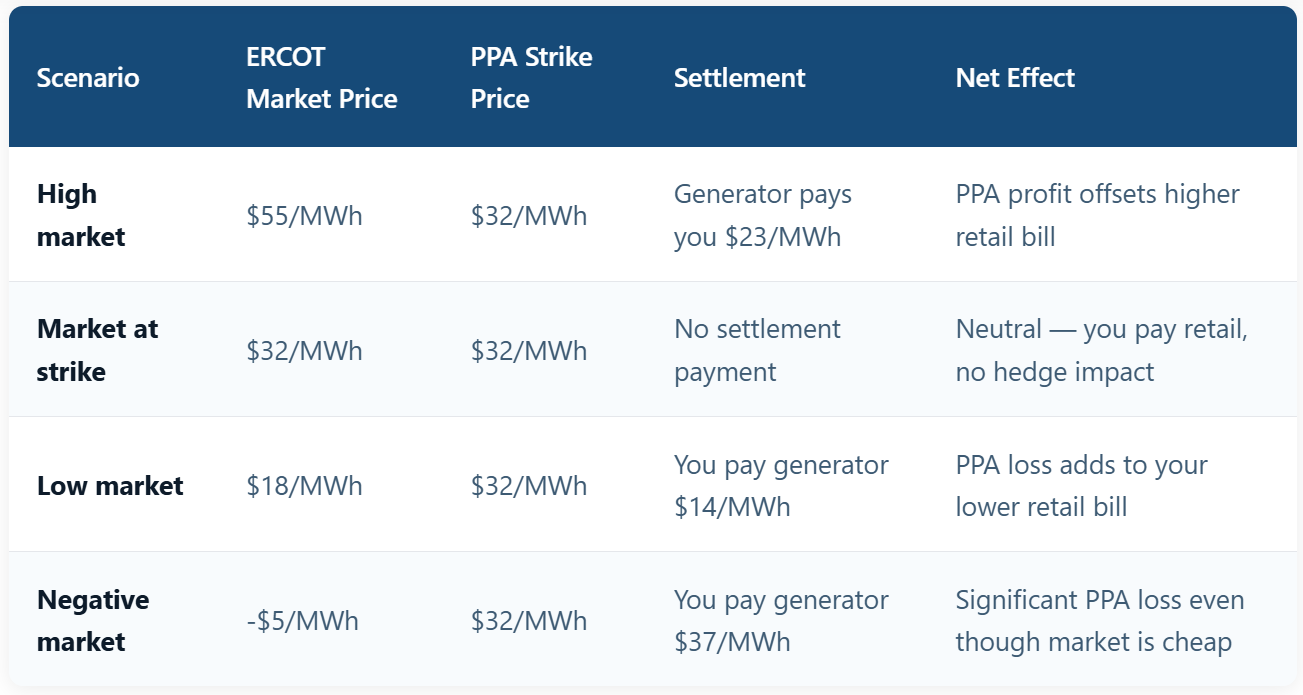
The negative market price scenario is not hypothetical. ERCOT regularly sees negative real-time prices during periods of high wind generation and low demand — particularly overnight in spring. When the project generates during these hours, you are paying the full difference between the strike price and the negative market price. This is one of the most misunderstood risks of virtual PPAs.
Advantages of Virtual PPAs
- Geographic flexibility. You can contract with a project anywhere on the ERCOT grid (or even out-of-state, though this increases complexity). Your physical location does not constrain project selection.
- No change to existing supply. Your retail electricity relationship stays with your current REP. The PPA is a separate financial overlay.
- Portfolio optimization. Multi-location businesses can enter a single virtual PPA that hedges the aggregate portfolio rather than negotiating physical PPAs at each location.
- Larger project access. Virtual structures allow you to participate in very large utility-scale projects that offer the lowest per-MWh pricing.
Risks of Virtual PPAs
Virtual PPAs carry several risks that physical PPAs mitigate or avoid. These risks are financial in nature and can result in significant costs if not properly understood and modeled:
Basis Risk
This is the single most important risk factor in a virtual PPA. Basis risk arises from the difference in wholesale electricity prices between the project's location (settlement point) and your load's location (settlement point). The PPA settlement is calculated at the project's settlement point. Your retail electricity cost is influenced by prices at your load's settlement point.
In Texas, transmission congestion creates significant basis differentials. A wind farm in West Texas may sell into the ERCOT market at $20/MWh, while Houston hub prices are $45/MWh at the same moment. If your PPA settles at the West Texas node, your hedge is less effective — you are hedging against a price that does not reflect your actual cost.
Basis risk has historically been 10-30% of total PPA value for West Texas wind projects selling to Houston-area buyers. Over a 15-year term, this can represent millions of dollars in value erosion that was not reflected in the developer's initial proposal.
Shape Risk
Renewable projects generate electricity when nature allows — not when you consume it. This creates a "shape mismatch" between PPA settlement periods and your consumption pattern:
- Wind PPAs: West Texas wind generation is strongest overnight and in spring — precisely when ERCOT market prices are lowest. Your PPA settles at these low-price hours, but you still need to buy electricity at higher prices during business hours when the wind is calm.
- Solar PPAs: Solar generates during daytime hours, which are typically moderate-to-high price periods. However, solar output drops to zero by evening — if your business operates evenings or 24/7, you have no hedge coverage for those hours.
Shape risk means the average market price during your PPA settlement hours is often different from — and frequently lower than — the average market price during the hours you actually consume electricity. The PPA developer's pro forma often uses a simple average market price that does not reflect this shape mismatch, making the deal look more attractive than it actually is.
Long-Term Price Risk
A PPA locks you into a fixed strike price (with a small escalator) for 10-25 years. This is a two-sided bet on future electricity prices:
- If wholesale prices rise significantly (due to gas price increases, carbon pricing, demand growth, grid constraints), your PPA becomes increasingly valuable — you are hedged at a below-market price while your competitors pay higher rates.
- If wholesale prices fall significantly (due to abundant cheap renewables, low gas prices, technological breakthroughs, or demand destruction), your PPA becomes a liability — you are locked into paying the strike price when market alternatives are cheaper.
The renewable energy build-out in Texas itself creates this risk. As more wind and solar capacity comes online, it pushes wholesale prices down during hours when renewables generate — which are the same hours your PPA settles. This is sometimes called "cannibalization risk" — the very success of renewables depresses the prices that make your renewable PPA financially attractive.
Counterparty and Credit Risk
PPA developers evaluate your creditworthiness carefully because they need confidence you will honor a multi-decade payment commitment. They may require corporate guarantees, letters of credit, or cash collateral. Conversely, you need to evaluate the developer's financial stability — if the project company or its parent becomes insolvent, your PPA's value and REC delivery are at risk.
Most project companies are special purpose vehicles (SPVs) with limited assets beyond the project itself. If the project underperforms or the developer encounters financial difficulty, your recourse may be limited.

Basis risk — the price difference between where power is generated in West Texas and where it is consumed in Houston — is the most commonly underestimated risk in virtual PPAs and can erode 10-30% of contract value.
Who Are PPAs Right For?
PPAs are not appropriate for every business. They make sense when several conditions align simultaneously:
Sufficient Scale
Most PPA developers require a minimum offtake of 5-20 MW of peak demand or 40,000-175,000 MWh of annual consumption. This puts PPAs in range for:
- Data centers — Typically 10-100+ MW with 24/7 flat load profiles that match well with blended renewable output.
- Large manufacturing facilities — Multi-shift operations with annual consumption exceeding 50,000 MWh.
- Multi-location chains — Aggregated load across 50+ locations (restaurants, retail, convenience stores) can reach PPA thresholds.
- Hospital networks and university campuses — Large institutional loads with long occupancy horizons.
Single-location businesses consuming less than 500,000 kWh/month are generally too small for a direct PPA. However, aggregation platforms and "PPA-in-a-box" products are emerging that allow smaller buyers to participate in pooled structures, though with less customization and different risk profiles.
Long-Term Occupancy or Operations Commitment
A 15-year PPA requires confidence that your business will be operating at the contracted scale for the duration. Businesses in leased spaces with uncertain renewal terms, companies in volatile industries facing potential downsizing, or organizations considering relocation face significant risk from a long-term volume commitment. Exiting a PPA early involves termination payments that can run into millions of dollars, calculated based on the remaining contract value and current market conditions.
Financial Sophistication
Virtual PPAs in particular require organizational capacity to understand energy market mechanics, basis differentials, settlement procedures, and derivative accounting. Your finance team needs to be comfortable with mark-to-market valuation, hedge effectiveness testing, and potentially complex balance sheet treatment. If these terms are unfamiliar to your CFO, your organization may not be ready for a virtual PPA without significant advisory support.
Sustainability Goals With Additionality Requirement
PPAs provide the strongest form of renewable energy claim because your purchase directly enables the construction of new generation capacity — this is called "additionality." Unlike buying unbundled RECs from the open market (which supports existing projects), a PPA creates new renewable capacity that would not exist without your commitment. For organizations with ambitious ESG targets, RE100 commitments, or Scope 2 emission reduction goals, this additionality is the primary non-financial driver of PPA adoption.
Financial Modeling: How to Evaluate a PPA Properly
Developer proposals typically present a PPA in the most favorable light — showing the strike price against a rising wholesale price forecast and highlighting cumulative savings. A proper evaluation requires independent modeling that accounts for the risks above:
Step 1: Build a Counterfactual
What would you pay without the PPA? Model your electricity costs under a standard retail contract (fixed or variable) for the same term, including realistic assumptions about future retail rate increases. This is your baseline for comparison.
Step 2: Model PPA Settlements Against Actual Generation Profiles
Do not use simple annual average prices. Use hourly generation profiles for the specific project type and location (wind farms in the Texas Panhandle have very different output profiles than solar in South Texas) and hourly ERCOT settlement prices at the project's node. This reveals the shape risk — the average settlement price during generation hours versus the average market price during your consumption hours.
Step 3: Quantify Basis Risk
Calculate the historical basis differential between the project's settlement point and your load zone. Model scenarios where congestion worsens (more renewable build-out in West Texas without matching transmission expansion) or improves (new transmission lines). Basis risk should be modeled as a distribution, not a single number.
Step 4: Include Firming and Balancing Costs
For physical PPAs, include the cost of REP supply for hours when the project is not generating. For virtual PPAs, include the retail electricity cost from your REP (which you still pay in full) and net it against the PPA settlement payments.
Step 5: Stress Test Scenarios
Run the model under adverse conditions: wholesale prices 30% below forecast (renewable build-out accelerates), basis differentials double, project generates 20% less than forecast (poor wind or solar years), negative price hours increase. If the PPA still delivers positive value under stress scenarios, the economics are robust. If it only works under the developer's optimistic assumptions, proceed with extreme caution.
Step 6: Calculate Net Present Value (NPV) and Payback
Discount future cash flows at your company's weighted average cost of capital. A PPA that shows positive NPV under base-case and moderate stress scenarios, with a reasonable payback period (typically 5-10 years for the best deals), is worth serious consideration. A PPA that only shows positive NPV under the developer's optimistic price forecast is a speculative bet on electricity prices, not a procurement strategy.
Accounting Treatment
The accounting treatment of PPAs depends on their structure and can have significant balance sheet implications:
- Physical PPAs are generally treated as executory contracts — recognized as operating expenses as electricity is delivered and consumed. No derivative accounting is required if the contract qualifies for the "normal purchases and normal sales" (NPNS) exception under ASC 815.
- Virtual PPAs are typically classified as derivatives under ASC 815 (US GAAP) or IFRS 9. This means they must be recorded at fair value on the balance sheet, with changes in fair value flowing through earnings each period (mark-to-market). This can create significant earnings volatility that does not reflect the underlying economics of your business.
- Hedge accounting may be available for virtual PPAs if you can demonstrate and document hedge effectiveness — linking the PPA to a specific forecasted purchase of electricity. Hedge accounting allows changes in fair value to flow through Other Comprehensive Income (OCI) rather than earnings, reducing income statement volatility. However, qualifying for hedge accounting requires rigorous documentation and ongoing effectiveness testing.
The accounting treatment should be evaluated with your finance team and auditors before signing. CFOs have rejected otherwise-attractive PPA deals because the earnings volatility from mark-to-market accounting was unacceptable to their board or investors.
Key Contract Provisions to Negotiate
PPA contracts are typically 50-150 pages of complex legal and commercial terms. While a full contract review requires experienced legal counsel, here are the provisions that matter most for your financial outcome:
- Settlement point and methodology. Exactly which ERCOT settlement point is used for settlement calculations? Is it the project's node, a hub price, or a load zone price? The choice directly affects basis risk.
- Curtailment risk allocation. When ERCOT curtails the project (instructs it to reduce output due to grid constraints or negative prices), who bears the cost? If you are still required to make settlement payments on curtailed volumes, you are taking on significant risk.
- Performance guarantees. Does the developer guarantee a minimum annual generation output? What happens if the project underperforms its P50 forecast? Performance shortfall provisions protect you against project underperformance.
- Termination provisions. Under what circumstances can either party terminate? What is the calculation methodology for termination payments? Is there a cap on your termination liability?
- Change-of-law provisions. What happens if regulatory changes (new transmission charges, carbon pricing, renewable mandates) materially change the economics? Is there a renegotiation mechanism or a walk-away right?
- REC delivery and vintage. Are RECs delivered monthly, quarterly, or annually? What vintage must they be? Can the developer substitute RECs from other projects if the contracted project underperforms?
- Credit support. What collateral or credit support is required from each party? How is credit support recalculated as market conditions change?
Alternatives to Direct PPAs
If your business is interested in renewable energy procurement but does not meet PPA thresholds or prefers lower complexity, several alternatives exist:
- Green retail plans. Many REPs offer electricity plans with bundled RECs, providing a simple way to claim renewable energy usage without PPA complexity. The additionality claim is weaker, but the operational simplicity is significant.
- Aggregated PPA platforms. Platforms like Microsoft's, Google's, or third-party aggregators pool multiple smaller buyers into a single PPA, allowing participation at lower individual thresholds. Terms are less customizable than a direct PPA.
- On-site generation. Rooftop solar, on-site wind (rare in commercial settings), or combined heat and power (CHP) systems generate electricity at your location, reducing your grid purchases. The economics depend heavily on your roof space, solar exposure, and utility interconnection costs.
- Unbundled REC purchases. The simplest option — buy RECs on the open market to match your consumption. Lowest cost, weakest sustainability claim, no hedge value.
The Bottom Line
PPAs represent the most sophisticated tier of commercial energy procurement in the Texas market. For businesses with the scale (5+ MW), the long-term operational commitment (10+ years), and the financial sophistication to model and manage the risks, a well-structured PPA can deliver below-market electricity costs, meaningful sustainability credentials, and long-term price certainty that no retail contract can match.
For businesses that lack any of those prerequisites, the risks and complexity outweigh the benefits. A well-negotiated retail contract with a hedging strategy and a green energy component can achieve many of the same goals — price certainty, cost management, sustainability claims — with far less risk and a fraction of the legal costs.
The most important step in evaluating a PPA is getting independent advice before you sign. The developer selling the PPA has an interest in closing the deal. Your energy broker or advisor has an interest in making sure the deal works for you over the full contract term — not just in the developer's year-one pro forma.