
Load Factor: The Hidden Metric That Controls Your Electricity Costs

Most Texas businesses evaluate their electricity costs by looking at two numbers: their per-kWh energy rate and their total monthly bill. But there is a third metric that has more influence on your effective electricity cost than either of those — and almost no one talks about it. That metric is your load factor.

Load factor determines what percentage of your bill goes to demand charges, how competitive your rate quotes will be, and which rate structure delivers the best value for your business. Improving your load factor is often the single highest-ROI energy management action a commercial electricity customer can take.


What Load Factor Is

Load factor is the ratio of your average electricity demand to your peak electricity demand over a given period. It measures how consistently you use power.

The formula is straightforward:

Load Factor = Total kWh Consumed / (Peak Demand in kW × Hours in Billing Period)

A load factor of 1.0 (or 100%) means you used electricity at a perfectly constant rate — your peak demand was the same as your average demand. A load factor of 0.3 (30%) means your average demand was only 30% of your peak — you had significant spikes relative to your baseline usage.


A Concrete Example

Take two businesses that both consumed 72,000 kWh in a 30-day month (720 hours):
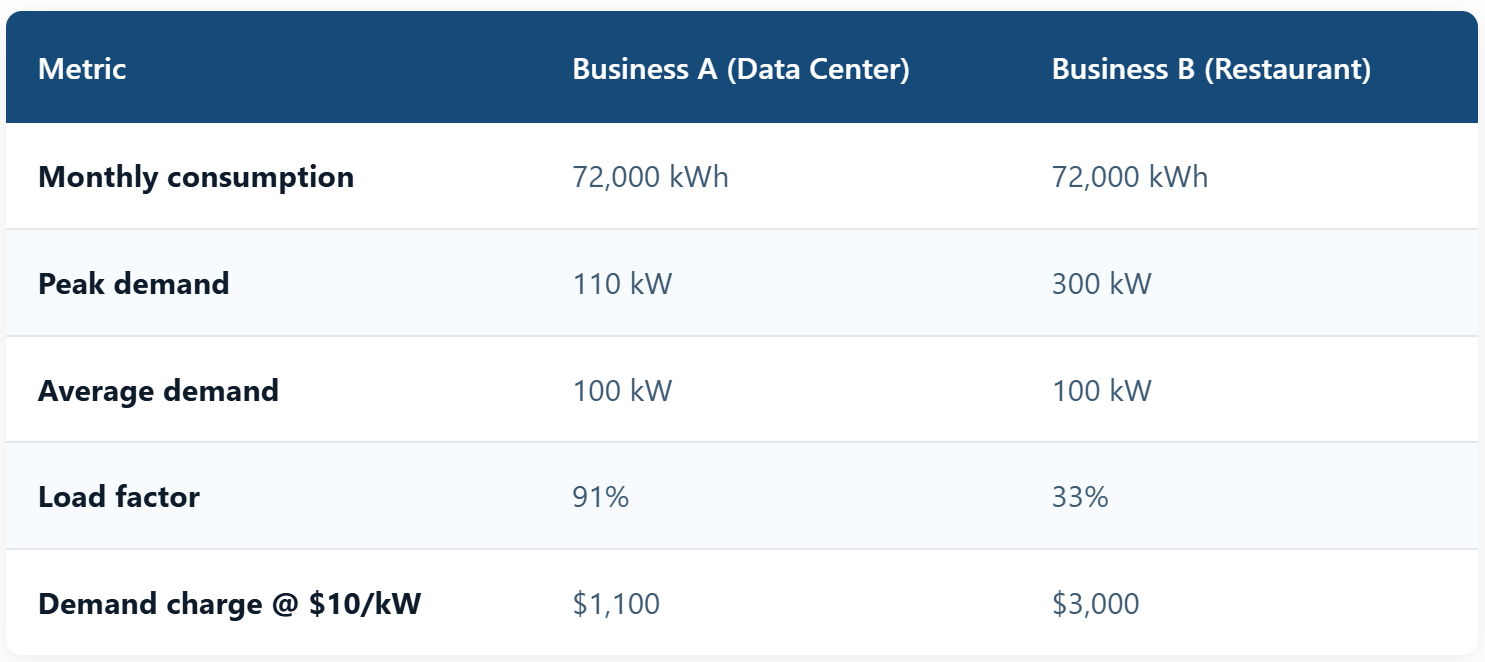

Both businesses used the same total electricity. But Business B pays $1,900 more per month in demand charges — $22,800 per year — because its peak demand is nearly three times higher than its average. That is the load factor penalty.

A high load factor (flat profile) means demand charges are a small percentage of your bill. A low load factor (peaky profile) means demand charges dominate.

Why Load Factor Matters Beyond Demand Charges

Demand charges are the most obvious cost impact, but load factor influences your electricity costs in several other ways. Think of it as a multiplier that touches almost every component of your electricity cost stack.


REP Pricing and Quote Competitiveness

When REPs evaluate your account to generate a rate quote, your load factor is one of the key inputs. High load factor customers are more attractive because their consumption is predictable and their peak-to-average ratio is low, which means less risk for the REP. As a result, businesses with high load factors typically receive more competitive rate quotes than businesses with the same total consumption but low load factors.

The rate difference is not trivial. Two businesses consuming 100,000 kWh/month might receive quotes that differ by $0.005-$0.015/kWh purely based on load factor. On 100,000 kWh/month, that is $500-$1,500/month or $6,000-$18,000/year — before you even look at demand charges. REPs do not always explain why one customer gets a better rate; load factor is often the hidden reason.


Rate Structure Optimization

Your load factor should directly inform your rate structure choice. Businesses with high load factors can capture more value from index-rate contracts because their consistent usage pattern means they buy most of their electricity during average-priced hours rather than during peaks. Businesses with low load factors are more exposed on index rates because their usage spikes tend to coincide with high-priced hours — exactly when wholesale prices are most expensive.

A rough rule: if your load factor is above 60%, index or hybrid rates deserve serious consideration. If your load factor is below 40%, a fixed rate is almost always the safer and often cheaper choice because your peaks align with the most expensive wholesale hours.


Infrastructure Costs and TDU Ratchets

From the grid's perspective, a low load factor customer requires more infrastructure capacity relative to the revenue they generate. This reality is reflected in TDU tariff structures — many TDU rate schedules include ratchet clauses that set minimum demand charges based on the highest peak recorded in the previous 12 months. A single demand spike can elevate your minimum demand charge for an entire year.

For example, if your typical peak demand is 150 kW but a simultaneous equipment startup event pushes you to 250 kW for a single 15-minute interval, some TDU tariffs will bill you based on 250 kW (or 80% of 250 kW = 200 kW) for the next 11 months, regardless of whether your actual peak returns to 150 kW. At $4/kW in TDU demand charges, that one 15-minute event costs you an extra $200-$400/month for a full year — $2,400-$4,800 from a single spike.


4CP Exposure

In ERCOT, your transmission costs are partly determined by the Four Coincident Peak (4CP) methodology. Your business's demand during the single highest-demand 15-minute interval in each summer month (June-September) determines your share of transmission costs for the following year. Low load factor businesses with high peaks are disproportionately exposed to 4CP costs because their demand spikes are more likely to coincide with the system peak.

Read more about how 4CP and demand-related costs work in our guide to capacity vs. energy charges.


Load Factor Benchmarks by Industry

Load factors vary widely by business type. Knowing where your industry typically falls helps you assess whether there is room for improvement:
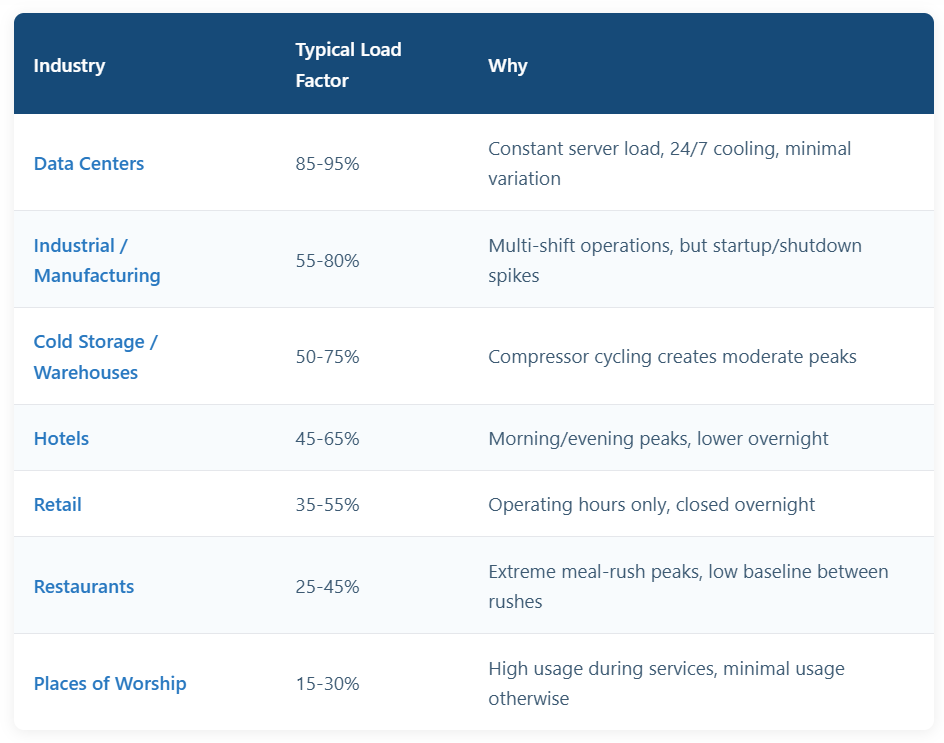

If your load factor is significantly below your industry benchmark, there is likely an operational issue or equipment behavior creating unnecessary peaks that can be addressed.


How to Calculate Your Load Factor

You need two numbers from your electricity bill:

  • Total kWh consumed — Found in the energy consumption section of your bill.
  • Peak demand in kW — Found in the demand charge section. This is the highest 15-minute average demand recorded during the billing period.

Then calculate: Load Factor = kWh / (Peak kW × Hours in period)

For a 30-day month: Load Factor = kWh / (Peak kW × 720)

Example: 60,000 kWh consumed, 200 kW peak demand, 720 hours in month.
Load Factor = 60,000 / (200 × 720) = 60,000 / 144,000 = 
0.417 (41.7%)

Calculate this for each of the last 12 months. Your load factor will vary seasonally — summer months often show lower load factors because HVAC creates afternoon peaks while evening and overnight usage stays low.


Real-World Load Factor Impact: A Dollar-for-Dollar Comparison

To see how load factor translates to real money, consider a mid-size retail store consuming 80,000 kWh/month. We will model the all-in cost at different load factor levels, holding total consumption constant:
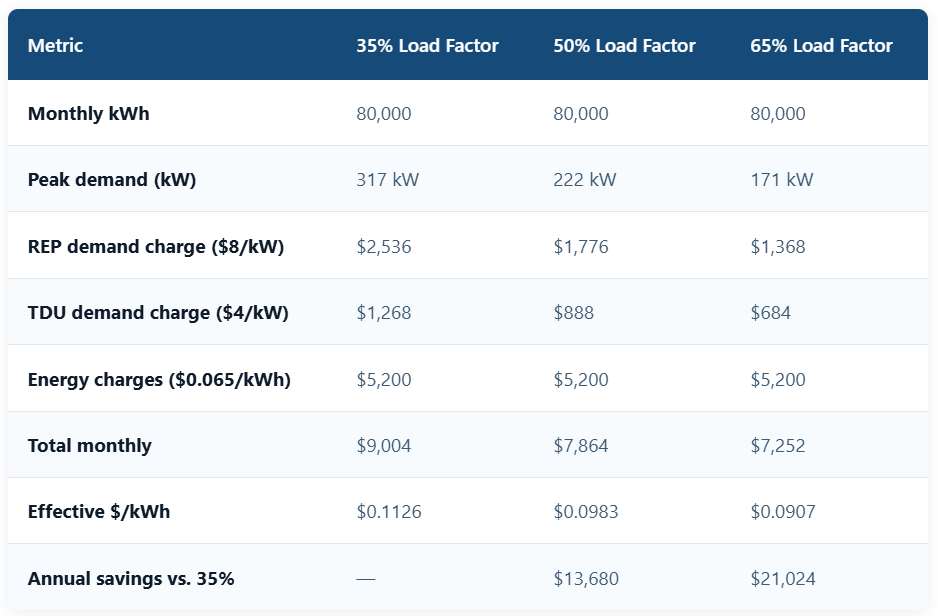

Moving from 35% to 65% load factor saves over $21,000/year — and the kWh consumed is identical. The entire savings comes from reduced peak demand. This is why load factor improvement often delivers bigger returns than rate-shopping alone.


How to Read Your Interval Data

Monthly bills show your peak demand as a single number, but understanding when and why your peaks occur requires interval data — the 15-minute demand readings that your smart meter records continuously. You can request interval data from your REP or TDU, typically as a CSV or Excel file.

Key patterns to look for in interval data:

  • Morning startup spikes — Does demand spike between 6-8 AM when everything starts up simultaneously? This is the most common and most fixable peak source.
  • Afternoon HVAC peaks — Does demand climb steadily through the afternoon as cooling load increases? This is structural in Texas summers but can be partially managed through pre-cooling strategies.
  • Equipment cycling coincidence — Do multiple large loads (compressors, chillers, ovens) cycle on at the same time? Building management system (BMS) scheduling can prevent overlap.
  • Anomalous single-interval spikes — Is your recorded peak driven by one or two intervals that are far above your normal peak? This suggests an isolated event (equipment malfunction, accidental simultaneous startup) rather than a systemic issue — and it is the cheapest type of peak to fix.
  • Weekend vs. weekday patterns — Some businesses have higher peaks on weekdays during full operations, while others (like restaurants) may peak on weekend evenings. Knowing your peak day-of-week pattern focuses your management efforts.

If you do not have access to interval data, start with the demand line on your electricity bill and calculate load factor monthly for at least 12 months. The seasonal variation will reveal whether your peaks are weather-driven (HVAC), operations-driven (equipment), or both.


Strategies to Improve Load Factor

Improving load factor means either reducing peaks, increasing baseline usage (filling the valleys), or both. The most practical approaches for commercial customers, ranked by cost-effectiveness:


1. Peak Shaving Through Load Staggering (No Cost)

Stagger the startup of heavy equipment so that multiple high-draw systems do not start simultaneously. This is the lowest-cost, highest-impact strategy for most businesses. A 15-30 minute staggered startup sequence for HVAC, kitchen equipment, production machinery, or compressors can reduce peak demand by 15-25% with no capital investment.

Implementation is simple: create a written startup checklist with timed intervals. For a restaurant, it might look like: 5:30 AM — walk-in compressors on; 5:45 AM — HVAC on; 6:00 AM — fryers and flat-tops on; 6:15 AM — ovens and warmers on. Without staggering, all of these might be switched on within 5 minutes, creating a demand spike 2-3x the steady-state load.


2. Demand Response and Load Shedding (Low Cost)

Identify non-critical loads that can be temporarily reduced during peak periods. For example, dimming non-essential lighting by 20%, pre-cooling spaces and then cycling HVAC off during the peak window, or deferring equipment like ice machines or water heaters to off-peak hours.

Many modern thermostats and building management systems can be programmed with demand limits — when the building's real-time demand approaches a threshold, the system automatically sheds loads in priority order. The cost is typically just programming time on equipment you already own.


3. Operational Scheduling (No Cost)

If you have energy-intensive processes that are time-flexible, schedule them during traditionally low-demand periods. Manufacturing facilities can shift certain production runs to second or third shifts. Restaurants can run prep activities (dishwashing, ice-making, dough proofing) outside of meal-rush hours. Hotels can schedule laundry loads during late morning when guest room HVAC demand is lowest.

The goal is not to reduce total consumption — it is to move consumption from peak hours into valleys, making the load profile flatter. Every kWh you move from a peak interval to an off-peak interval improves your load factor at zero cost.


4. Equipment Upgrades (Moderate Cost, High ROI)

Older HVAC compressors, motors, and refrigeration units often draw significantly more power during startup than modern variable-speed equipment. Replacing aging equipment with variable-frequency drive (VFD) motors or inverter-driven compressors can reduce startup peaks by 50-70%. The load factor improvement alone can justify the equipment investment through demand charge savings.

Specific high-ROI upgrades include:

  • VFD on HVAC blower motors — Eliminates hard-start current surges. Typical payback: 18-36 months from demand charge savings alone.
  • Soft starters on compressors — Reduces inrush current from 6-8x running amps to 2-3x. Payback: 12-24 months for large refrigeration compressors.
  • Inverter-driven chillers — Modulates capacity smoothly rather than staging on/off. Eliminates cycling peaks.
  • LED lighting retrofit — Reduces total connected load, which lowers both consumption and contribution to peak demand. Often has the shortest payback of any upgrade.


5. Battery Energy Storage (High Cost, Best for Extreme Peaks)

For businesses with very high demand charge exposure, battery storage systems can shave peaks by discharging stored energy during high-demand periods. The economics depend on your demand charge rate, peak-to-average ratio, and available space. As battery costs continue to decline, this option is becoming viable for a broader range of commercial applications.


Battery economics work best when: demand charges exceed $12/kW/month, your peak-to-average ratio is above 2:1, and your peaks are short-duration (1-2 hours). A 100 kW / 200 kWh battery system costing $80,000-$120,000 installed can save $15,000-$25,000/year for a facility with $15/kW demand charges and a peaky profile — a 4-6 year payback.


Modern energy management systems can automatically stagger equipment startups and shed non-critical loads to keep peak demand in check.

Seasonal Load Factor Variation and What to Do About It

In Texas, load factor fluctuates significantly between seasons due to HVAC patterns:

  • Spring/Fall (Best) — Mild weather means HVAC contributes less to peaks. Load factor typically 5-15 points higher than summer for the same business.
  • Summer (Worst for most) — Afternoon cooling creates sharp peaks, especially for buildings with large roof areas exposed to direct sun. Load factor drops as AC peaks rise while overnight baseload stays flat.
  • Winter (Variable) — Depends on heating type. Electric heat pump buildings see winter peaks approaching summer levels. Gas-heated buildings may maintain good winter load factors.

This seasonal variation matters because TDU demand ratchets are often based on the highest peak in any month of the past 12. Your July peak determines your minimum demand charge through the following June. Aggressive summer peak management — even if load factor is naturally lower — prevents the ratchet from locking in elevated charges year-round.


Load Factor and Contract Negotiations

When you or your broker approach REPs for rate quotes, a higher load factor strengthens your negotiating position in multiple ways:

  • Better energy rates — REPs evaluate commercial accounts partly on load factor because it predicts the cost and risk of serving your account. A customer with 70% load factor is cheaper to serve than one with 35% load factor at the same total consumption, and REPs price accordingly.
  • Access to more REPs — Some REPs have minimum load factor thresholds for their most competitive rate tiers. Below 30% load factor, certain index products and wholesale-plus structures may not be offered at all.
  • Hybrid and block-and-index eligibility — Sophisticated procurement structures like block-and-index work best with predictable baseload — i.e., high load factor. Low load factor customers cannot effectively structure a block because their baseload is an unreliable floor.
  • Multi-year term leverage — REPs offer better margins on longer terms, but only if the customer's load profile justifies the risk. High load factor makes REPs more willing to offer aggressive pricing on 36+ month contracts.

If you have improved your load factor since your last contract, make sure your broker presents updated interval data to REPs when soliciting quotes. Historical load factor data that shows a peaky profile will result in worse quotes than current data reflecting your improved profile. Specifically, ask your broker to include the most recent 3-6 months of interval data rather than the full 12-month history if the recent data reflects improvements.


Common Load Factor Mistakes

Several common missteps prevent businesses from capturing load factor value:

  • Focusing only on kWh reduction — Businesses spend thousands on LED retrofits and efficient HVAC to reduce consumption but ignore demand. Reducing kWh without reducing peaks can actually worsen load factor because you are shrinking the numerator without touching the denominator.
  • Not tracking load factor monthly — You cannot improve what you do not measure. Pull your demand and consumption numbers monthly and track the ratio. Set a target and review against it.
  • Ignoring one-time spikes — A single anomalous peak from a maintenance event, emergency generator test, or equipment malfunction gets baked into your demand ratchet. Identifying and preventing these isolated events can save more than any operational change.
  • Over-sizing equipment — New HVAC systems sized for worst-case conditions with no VFDs create enormous startup peaks relative to average running load. Always specify variable-speed drives when replacing major equipment.
  • Not communicating with your broker — Your broker needs to know your load factor when shopping rates. If they are only looking at annual kWh, they are leaving money on the table.

The Bottom Line

Load factor is the metric that connects your operational behavior to your electricity costs. A low load factor means you are paying for grid capacity you barely use. A high load factor means you are extracting maximum value from every dollar of demand charge and getting better rate quotes from REPs.


The action sequence is clear: calculate your current load factor from the last 12 bills. Compare it to your industry benchmark. If there is a gap, start with no-cost fixes (staggering, scheduling) and measure the impact month-over-month. Then address equipment and capital improvements with clear payback calculations. Fix the load factor first, then shop for the best rate — you will get better quotes with a better profile, and the demand charge savings compound on top of any rate improvement.



May 9, 2026
Timing is everything in the Texas electricity market. The difference between renewing your commercial electricity contract at the right time versus the wrong time can amount to tens of thousands of dollars over the life of your agreement. Yet most Texas businesses treat contract renewal as an afterthought — something they deal with reactively rather than strategically. In a deregulated market like ERCOT , you have the power to choose your supplier and negotiate your terms. But that power is only useful if you exercise it at the right moment. This guide explains exactly when and how to approach your commercial electricity contract renewal for maximum savings. Know Your Contract End Date This sounds obvious, but it is the number one reason businesses overpay for electricity. The majority of commercial customers we work with do not know when their current electricity contract expires until it is too late. When your contract ends without a new agreement in place, one of two things typically happens — and neither one is good for your business: Auto-renewal at a holdover rate. Some contracts include a provision that automatically rolls you into a new term, but at a significantly higher rate. These holdover rates are rarely competitive — they are set by the REP without any negotiation, and they can be 20-50% above market rates. Month-to-month variable pricing. Without a contract in place, you default to a month-to-month variable rate that fluctuates with the wholesale market. This means you have no price protection during peak demand periods when electricity is most expensive. Both scenarios cost you money, and both are entirely avoidable. The fix starts with one simple action: find out when your current contract ends and put that date on your calendar — with a reminder set 120 days in advance. The 3-4 Month Rule The single most important tactical advice for contract renewal is this: start shopping 90 to 120 days before your contract expires. There are several reasons this timeline works: Forward pricing availability. Electricity suppliers offer forward pricing — rates locked in today for a future start date. These forward offers are typically available 30 to 120 days out. Starting early gives you access to the widest range of forward pricing options. Competitive leverage. When suppliers know you are shopping well in advance, they compete harder for your business. A business that calls one week before contract expiration has limited leverage because the supplier knows you are under time pressure. Time to compare. Evaluating bids from multiple suppliers takes time. You need to compare not just the headline rate, but the contract terms, fee structures, pass-through mechanisms, and early termination provisions. Our guide to fixed vs. variable rate electricity breaks down each option. Rushing this process leads to overlooked details that cost money. Market flexibility. Starting early means you can watch the market for favorable pricing windows. If rates are trending down, you can wait a few weeks. If rates are about to spike (heading into summer, for example), you can lock in before the increase. The Renewal Timeline 120 days out: Begin gathering your usage data and contacting brokers or suppliers. 90 days out: Review competitive bids and compare options. 60 days out: Finalize your selection and execute the contract. 30 days out: Confirm the switch is on track with your new supplier and ERCOT. Market Timing: When Are Texas Electricity Prices Lowest? The Texas electricity market follows predictable seasonal patterns driven largely by weather and natural gas prices. Understanding these patterns can help you time your contract renewal for the best possible rates. Generally, the best time to lock in a commercial electricity rate in Texas is between October and March. During this window, electricity demand is lower (mild weather means less HVAC load), natural gas prices — which drive the marginal cost of electricity generation in Texas — tend to be more stable, and suppliers are more willing to offer competitive forward pricing to secure volume for the coming year. Conversely, the most expensive time to sign a contract is during the summer months, particularly June through August. Wholesale prices are elevated due to peak cooling demand, and suppliers price their forward contracts to reflect the risk of extreme heat events. If you lock in a 24- or 36-month contract at summer peak pricing, you are paying an inflated rate for the entire term — not just the summer months. Timing your contract renewal to coincide with lower market periods can save your business thousands over the contract term. That said, the "best time" is a general guideline, not a guarantee. Unusual weather patterns, natural gas supply disruptions, changes in generation capacity, and regulatory developments can all move prices outside of their typical seasonal ranges. This is why ongoing market monitoring matters — and why working with a professional who tracks these factors daily is so valuable. Watch the Calendar, Not Just the Market Beyond general seasonal trends, several specific calendar events and market factors can significantly impact electricity pricing in Texas: ERCOT capacity and reserve margin reports. ERCOT publishes seasonal assessments of expected generation capacity versus demand. When reserve margins are tight — meaning the grid has less cushion between available supply and expected demand — forward prices tend to rise as suppliers price in the higher risk of scarcity events. Hurricane season (June-November). Gulf Coast hurricanes can disrupt natural gas production and electricity transmission infrastructure. The mere forecast of an active hurricane season can push forward prices higher as suppliers hedge against potential supply disruptions. Planned generation outages. Power plants schedule maintenance during lower-demand periods, but the timing and duration of these outages affects available supply. When multiple plants are offline simultaneously, prices can rise even during typically mild periods. Natural gas market movements. Since natural gas is the primary fuel for Texas electricity generation, significant movements in the Henry Hub benchmark directly impact electricity forward pricing. A cold winter that drives up natural gas demand nationally can raise Texas electricity prices even before summer arrives. Tracking all of these factors yourself is a full-time job. This is one of the core services an energy broker provides — continuous market monitoring so that when it is time to renew your contract, you are making a decision based on current conditions, not last month's assumptions. Early Termination: When It Makes Sense to Break a Contract Sometimes the smartest move is not waiting for your contract to expire — it is getting out early. If market rates have dropped significantly below your current locked-in rate, paying the early termination fee (ETF) and signing a new contract at lower rates can actually save you money over the remaining term. Here is how to evaluate whether early termination makes financial sense: Calculate your remaining cost. Multiply your current rate by your expected consumption for the remaining months of your contract. This is what you will pay if you stay. Get current market pricing. Obtain competitive bids for a new contract covering the same remaining period. Calculate what you would pay at the new rate. Add the ETF. Your current contract specifies the early termination fee — typically a per-kWh charge multiplied by your remaining expected usage, or a flat dollar amount. Compare totals. If the new contract cost plus the ETF is less than the cost of staying on your current contract, early termination is the financially rational choice. This calculation is straightforward in principle, but the details matter. Some ETFs are structured to decrease over the contract term, making termination more attractive as you approach expiration. Others have minimum charges that make early termination prohibitively expensive regardless of market conditions. An experienced broker can run these numbers for you and tell you exactly where the break-even point is. How a Broker Helps With Contract Renewals The businesses that consistently get the best electricity rates in Texas are not the ones who happen to get lucky with timing. They are the ones who have a professional managing their energy procurement on an ongoing basis. Here is what a good energy broker does for you around contract renewal: Tracks your contract dates. You do not need to set calendar reminders or dig through filing cabinets to find your contract terms. Your broker knows exactly when every agreement expires and starts the renewal process at the optimal time. Monitors market conditions. Instead of checking electricity prices yourself (which most business owners have neither the time nor the expertise to do meaningfully), your broker is watching daily market movements and will advise you on when conditions favor locking in a rate. Solicits competitive bids. Rather than calling individual REPs one at a time, your broker sends your usage profile to 25+ suppliers simultaneously, generating a competitive bidding environment that drives prices down. Reviews contract terms. The headline rate is only part of the picture. Your broker reviews the full contract for unfavorable terms, hidden fees, pass-through mechanisms, and termination provisions that could cost you down the line. Provides continuity. Your broker retains your historical usage data, knows your business's energy profile, and understands your preferences from previous renewal cycles. This institutional knowledge means each renewal is more efficient and better tailored than the last. All of this comes at no cost to your business — the broker is compensated by the supplier, not by you.  A broker manages the entire renewal process — from market monitoring to contract execution — so you can focus on running your business. Take Control of Your Next Renewal Your commercial electricity contract is one of the largest controllable expenses in your business. Treating renewal as a strategic decision rather than an administrative task can save you thousands of dollars every year. The key principles are simple: know your contract end date, start shopping 90-120 days early, time your renewal to avoid peak market periods, and work with a professional who monitors the market and negotiates on your behalf. For more ways to reduce costs, see our guide to lowering commercial electricity bills . Businesses that follow this approach consistently pay less for electricity than those who let contracts auto-renew or wait until the last minute. If you do not know when your current contract expires, that is the first thing to fix.
May 9, 2026
Texas is one of the few states in the country with a fully deregulated electricity market. That means businesses operating within the ERCOT grid have the freedom to choose their Retail Electric Provider (REP) — a significant advantage that can translate into real savings on one of your largest operating expenses. But freedom of choice comes with complexity. There are more than 25 licensed REPs serving the Texas commercial market, each offering dozens of plans with varying rate structures, contract terms, and fee schedules. Navigating this landscape on your own is time-consuming, and without market expertise, it is easy to leave money on the table. That is why a growing number of Texas businesses — from single-location restaurants to multi-site industrial operations — work with energy brokers rather than going directly to providers. What Does an Energy Broker Actually Do? An energy broker acts as an intermediary between your business and multiple electricity suppliers. Rather than you contacting each REP individually to request pricing, your broker handles the entire process on your behalf. Here is how it typically works: The broker collects your usage data. This includes your historical consumption (usually 12 months of usage history), your current rate and contract terms, your meter information, and your TDU service area. The broker solicits competitive bids. Using your usage profile, the broker requests pricing from multiple suppliers simultaneously. This creates a competitive bidding environment — suppliers know they are competing against each other, which drives prices down. The broker presents your options. You receive a side-by-side comparison of bids from multiple suppliers, including the rate per kWh , contract length, rate structure ( fixed, variable, or hybrid ), and any fees or special terms. You choose. The broker explains the options and makes recommendations based on your business's needs, but the final decision is always yours. The broker manages the transition. Once you select a supplier, the broker handles the contract execution and coordinates with ERCOT for the switch. There is no interruption to your service.  The most important thing to understand is that the broker is paid by the supplier, not by you. REPs build a small commission into their pricing to compensate the broker. This is the same commission structure that exists whether you go through a broker or not — when you go direct, the REP's internal sales team earns that same margin. Using a broker does not add cost to your bill.
May 9, 2026
When most Texas business owners think about their electricity cost, they think about one number: the per-kWh rate. That number represents energy charges — what you pay for the volume of electricity you consume. But hidden beneath that headline rate is a second, often larger cost component that most businesses never scrutinize: capacity charges. These charges — which show up as demand charges , transmission demand fees, and various per-kW assessments — pay for the grid's ability to deliver power at your peak consumption level, regardless of how much total energy you use. Understanding the fundamental difference between energy and capacity costs is essential for commercial electricity buyers who want to move beyond surface-level rate shopping and actually control their total cost of power. This guide breaks down both cost components in depth, explains how each is calculated, identifies the trends driving each component, and provides strategies for managing both. The Fundamental Distinction Every dollar on your commercial electricity bill ultimately pays for one of two things: Energy Costs: Paying for Fuel and Generation Energy charges pay for the actual electricity you consume — the kilowatt-hours (kWh) that powered your lights, HVAC, equipment, and operations during the billing period. These charges reflect the cost of generating electricity: the fuel (natural gas, wind, solar), the operating costs of power plants, and the wholesale market dynamics that determine the price at which generators sell their output. Energy charges are volumetric — they scale directly with how much electricity you use. If you use twice as much electricity, your energy charges roughly double. If you shut down for a week, your energy charges drop proportionally. On your bill, energy charges typically appear as: Energy charge (per kWh) from your REP TDU energy delivery charge (per kWh) from your TDU Fuel factor or energy pass-through charges (on some contract structures)  Capacity Costs: Paying for Infrastructure and Readiness Capacity charges pay for the grid's ability to deliver power at the rate you need it — measured in kilowatts (kW) of peak demand. These charges cover the physical infrastructure (transformers, substations, distribution lines, transmission towers) that must be sized to handle your maximum draw, the generation capacity that must be available to serve peak system-wide demand, and the ancillary services that keep the grid stable. Capacity charges are demand-based — they scale with the highest rate at which you consume electricity at any point during the billing period, not the total volume you consume. Two businesses can use the exact same total kWh in a month but pay dramatically different capacity charges if one draws power steadily and the other draws it in sharp peaks. On your bill, capacity charges typically appear as: TDU demand charge (per kW) — often the largest single capacity-related line item Transmission demand charge (per kW) — covering high-voltage transmission infrastructure REP demand charge (per kW) — some contracts include a supply-side demand component Coincident peak (4CP) charges — based on your usage during ERCOT system peak periods Capacity obligation or ancillary service charges — covering grid reliability requirements
May 9, 2026
Restaurants are among the most energy-intensive businesses in the commercial sector. Between commercial kitchen equipment running at full capacity during service, walk-in coolers and freezers operating around the clock, HVAC systems battling Texas heat, and hood ventilation fans that never stop, electricity is often the second-largest operating expense for Texas restaurants — right behind labor. Our restaurants and food industry page covers how we help operators across the state. The good news is that operating in ERCOT's deregulated electricity market means you have options. Unlike states where a single utility dictates your rate, Texas restaurant operators can choose their commercial electricity supplier, negotiate their contract terms, and implement operational strategies that directly reduce what they pay. This guide covers the practical, high-impact actions you can take to bring those electricity costs down. Why Restaurant Electricity Bills Are So High Before you can fix the problem, it helps to understand why restaurants use so much electricity compared to other commercial businesses of similar size. The answer comes down to two factors: total consumption and peak demand. On the consumption side, restaurants operate energy-hungry equipment for extended hours: Walk-in coolers and freezers run 24 hours a day, 7 days a week. These are the baseline of your electricity usage, drawing power even when the restaurant is closed. Commercial ovens, fryers, and grills consume massive amounts of electricity during prep and service. A single commercial convection oven can draw 10-15 kW. HVAC systems work overtime in Texas, especially from May through September. The kitchen generates significant heat, so your cooling system is not just fighting outdoor temperatures — it is fighting the heat your own equipment produces. Hood ventilation systems are required by code to run whenever cooking equipment is in operation, and they pull conditioned air out of the building, forcing the HVAC to work harder. Lighting, POS systems, dishwashers, and ice machines round out a substantial base load that runs through every shift. All of this equipment running simultaneously is what drives the second factor — peak demand — which is where the real cost pain point lies for most restaurants.
Show More