
Understanding ERCOT Wholesale Pricing and What It Means for Your Business
Every commercial electricity rate in Texas — whether fixed, variable, or hybrid — is ultimately derived from the wholesale market operated by ERCOT. Understanding how wholesale pricing works gives you a significant advantage when negotiating commercial electricity contracts, evaluating rate structures, and timing your procurement decisions. This is the knowledge that separates businesses that passively accept whatever rate they are offered from those that actively manage energy as a strategic cost center.
How the ERCOT Wholesale Market Works
ERCOT operates two primary markets for electricity: the Day-Ahead Market (DAM) and the Real-Time Market (RTM). Both are auction-style markets where generators submit offers to sell electricity and the market clears at prices determined by supply and demand. Together, these two markets form the pricing backbone of the entire Texas electricity system.
The Day-Ahead Market (DAM)
The DAM operates exactly as the name implies — one day before electricity is actually consumed. Each day by 10:00 AM, generators, REPs, and other market participants submit their bids and offers for every hour of the following day. ERCOT runs a security-constrained economic dispatch algorithm that determines which generators will run and at what price for each hour.
The DAM serves as the primary forward market for electricity. It allows market participants to lock in prices and quantities before real-time delivery, reducing uncertainty for both generators and load-serving entities (your REP). Roughly 95% of all electricity consumed in ERCOT is financially settled through the Day-Ahead Market. This makes it the dominant price discovery mechanism — when energy professionals talk about "the ERCOT price," they are usually referencing DAM clearing prices.
DAM prices are published as Locational Marginal Prices (LMPs) for each settlement point on the grid. These LMPs reflect the marginal cost of serving the next megawatt of load at each location, accounting for three distinct components:
- Energy Component — The cost of generating the next MWh at the system level. This is driven primarily by fuel costs (natural gas, in most hours).
- Congestion Component — The incremental cost caused by transmission constraints. If a transmission line between a cheap generator and a load zone is at capacity, the congestion component reflects the cost of dispatching a more expensive local generator instead.
- Loss Component — The cost of electrical energy lost during transmission. Electricity dissipates as heat as it travels through wires — roughly 2-5% over long distances. Locations far from generation sources have higher loss components.
These three components are additive: LMP = Energy + Congestion + Losses. Understanding this decomposition matters because it explains why two businesses in different parts of Texas can face meaningfully different wholesale costs even during the same hour.
The Real-Time Market (RTM)
The RTM operates continuously, dispatching generators every five minutes to balance actual supply and demand in real time. When actual conditions deviate from what was scheduled in the Day-Ahead Market — higher-than-expected demand, a generator tripping offline, unexpected wind generation — the Real-Time Market adjusts.
Real-time prices are far more volatile than day-ahead prices. On a mild spring day, RTM prices might hover around $20-$30/MWh. During a summer heat wave when the grid is stressed, they can spike to $2,000-$5,000/MWh within minutes. During extreme events, ERCOT prices can hit the current system-wide offer cap of $5,000/MWh.
The difference between DAM and RTM prices in any given interval is called the "basis" or "imbalance." If you bought 100 MWh in the DAM at $40/MWh but only consumed 90 MWh, the 10 MWh difference is settled at the RTM price. If the RTM price was $30/MWh, you effectively sold back 10 MWh at a $10 loss per MWh. If RTM spiked to $200/MWh, you sold back at a $160 gain. This imbalance settlement is a key source of profit and risk for REPs.
For businesses on index-rate plans, the settlement mechanism in their contract determines which market — DAM or RTM — their rate is based on. This distinction matters enormously. A contract settled against real-time prices exposes you to those five-minute price spikes, while a DAM-settled contract provides somewhat more predictability. Some index products blend the two, using DAM for baseload hours and RTM for deviations.

Real-time prices can spike dramatically within minutes — day-ahead prices are more stable but still reflect fundamental supply and demand dynamics.
The Ancillary Services Market
Beyond energy, ERCOT operates an ancillary services market that is often overlooked but adds real cost to commercial electricity rates. Ancillary services are the reserve products that keep the grid stable — generators that stand ready to ramp up or down on short notice to balance unexpected supply-demand imbalances.
ERCOT procures several categories of ancillary services:
- Regulation Up / Regulation Down — Generators that adjust output second-by-second to maintain 60 Hz frequency. The fastest-responding reserve product.
- Responsive Reserve Service (RRS) — Resources that can ramp within 10 minutes to replace a sudden generation loss (like a large plant tripping offline).
- ERCOT Contingency Reserve Service (ECRS) — A newer product introduced in 2023, providing 10-minute reserves specifically for reliability during tight conditions.
- Non-Spinning Reserve — Offline generators that can start and synchronize within 30 minutes if needed.
These ancillary service costs are passed through to retail customers as part of your all-in rate. They typically add $2-$5/MWh during normal conditions, but can spike dramatically during scarcity events — sometimes exceeding the energy price itself. When your REP quotes an index rate with "ancillary pass-through," this is the cost they are referencing. On a fixed-rate contract, your REP has already estimated and embedded these costs into your locked rate.
What Drives Wholesale Prices
ERCOT wholesale prices are driven by the interplay of several fundamental factors. Understanding these drivers helps you anticipate market conditions and make better procurement decisions.
Natural Gas Prices
Natural gas plants set the marginal price in ERCOT for most hours of the year. When gas prices rise, wholesale electricity prices follow. The key benchmark is the Houston Ship Channel natural gas price, which is the primary gas pricing point for Texas generators. As of 2026, natural gas fuels approximately 40-45% of Texas electricity generation and is the marginal fuel (price-setting) for the majority of hours.
The relationship is roughly linear during normal conditions: a $1/MMBtu increase in gas prices translates to approximately $7-$10/MWh increase in wholesale electricity prices, depending on the efficiency (heat rate) of the marginal gas plant. The math works like this: if a Combined Cycle Gas Turbine (CCGT) has a heat rate of 7,000 BTU/kWh and gas costs $3/MMBtu, the fuel cost alone is $21/MWh. A less efficient peaker plant with a 10,500 BTU/kWh heat rate running the same gas costs $31.50/MWh — and peakers set the price during high-demand hours.
This gas-to-power linkage is the single most important pricing relationship in ERCOT. When evaluating forward electricity contracts, check where Henry Hub and Houston Ship Channel gas futures are trading — they will tell you whether current electricity forward prices are reasonable or inflated.
Weather and Temperature
Texas electricity demand is heavily weather-driven. Summer cooling load is the dominant factor — when temperatures exceed 100°F across the state for extended periods, electricity demand surges as commercial and residential air conditioning runs at maximum capacity. ERCOT peak demand records are almost always set during July or August heat waves.
The relationship between temperature and demand is non-linear. Going from 95°F to 100°F adds proportionally more load than going from 85°F to 90°F, because buildings lose thermal efficiency, AC systems run longer cycles, and more units switch from economizer mode to full mechanical cooling. A multi-day heat dome where overnight lows stay above 80°F is particularly dangerous for prices because buildings never cool down and demand stays elevated even at 3 AM.
Winter weather events also cause dramatic price spikes, though less frequently. The February 2021 Winter Storm Uri demonstrated the extreme end of this risk, when simultaneous demand spikes (heating load) and supply failures (frozen generators, gas supply disruptions) caused prices to sustain the $9,000/MWh cap for multiple days. ERCOT has since made weatherization improvements, but winter risk remains a structural feature of the Texas market.
Wind and Solar Generation
Texas leads the nation in wind generation (over 40,000 MW of installed capacity) and has rapidly growing solar capacity (over 20,000 MW). When wind is blowing strong — particularly overnight, when demand is low — wholesale prices can drop to zero or even go negative (generators effectively pay to keep running). West Texas wind generation is highest during spring nights, which is one reason fall-through-spring is typically the best time to lock in fixed-rate contracts.
Solar generation follows a predictable daily pattern: ramping up after sunrise, peaking around 1-2 PM, and declining to zero by sunset. This creates the "duck curve" — net demand (total demand minus solar) drops during midday but surges in the evening as solar disappears and residents come home. The evening ramp (4-8 PM) is becoming an increasingly expensive period as the grid must rapidly dispatch gas plants to replace declining solar output.
Conversely, when wind drops during a summer heat wave — a scenario called a "wind drought" — the loss of 15,000-25,000 MW of expected wind generation forces expensive gas peakers and other high-cost resources online, pushing prices sharply higher. Wind droughts are the most dangerous price event for index-rate customers because they combine high demand (heat) with low supply (no wind) simultaneously.
Transmission Congestion
ERCOT is not a single uniform market — prices vary by location based on transmission constraints. When cheap wind power generated in West Texas cannot be fully delivered to demand centers in Houston or Dallas due to transmission line capacity limits, Houston-area prices can be significantly higher than West Texas prices. This congestion component is embedded in the Locational Marginal Price.
The major congestion corridors in ERCOT include:
- West-to-East (CREZ lines) — Wind-rich West Texas to demand-heavy North/Houston zones. Despite massive CREZ transmission buildout completed in 2013, congestion still occurs during high wind output.
- South-to-Houston — Coastal wind and solar in the Rio Grande Valley competing for limited transmission into the Houston load pocket.
- North-to-Houston — When Dallas/Fort Worth area generation is needed in Houston but transmission paths are constrained.
- Valley Import — The Rio Grande Valley is a chronically congested load pocket with limited local generation and import capability.
For large commercial customers, understanding your settlement point's congestion exposure can reveal why your index rate behaves differently than headline ERCOT hub prices suggest. A business in Houston's load zone might consistently pay $3-$8/MWh more than the ERCOT-wide hub price due to congestion — over a year, that adds up to thousands of dollars for a mid-size facility.
Reserve Margins and the ORDC Scarcity Pricing Mechanism
ERCOT publishes reserve margin forecasts that indicate how tight supply-demand conditions are expected to be. When reserves drop below certain thresholds, ERCOT implements an Operating Reserve Demand Curve (ORDC) that adds a scarcity price adder to wholesale prices.
The ORDC works on a graduated scale. Here is a simplified view of how the adder escalates:
- Reserves above 3,000 MW — ORDC adder is minimal, often near $0. Grid is comfortable.
- Reserves at 2,000-3,000 MW — Adder begins climbing. Market starts pricing in scarcity risk. Prices may jump $50-$200/MWh above the energy-only clearing price.
- Reserves at 1,000-2,000 MW — Adder escalates aggressively. ERCOT may issue conservation appeals. Energy + ORDC can push prices to $1,000-$3,000/MWh.
- Reserves below 1,000 MW — Full scarcity pricing. Prices approach the $5,000/MWh cap. ERCOT activates emergency procedures, load curtailment may begin.
The ORDC was redesigned after Winter Storm Uri to be more aggressive — producing higher price signals earlier to incentivize generator investment and demand response. For index-rate customers, ORDC adders are the primary source of price spike risk during tight summer conditions.
Watching ERCOT's seasonal reserve margin assessments (published in the Capacity, Demand, and Reserves report) gives forward-looking insight into whether the upcoming summer or winter is likely to see elevated pricing.
Seasonal Price Patterns in ERCOT
Wholesale prices follow predictable seasonal patterns driven by weather, renewable output, and demand cycles. Understanding these patterns is essential for contract timing:
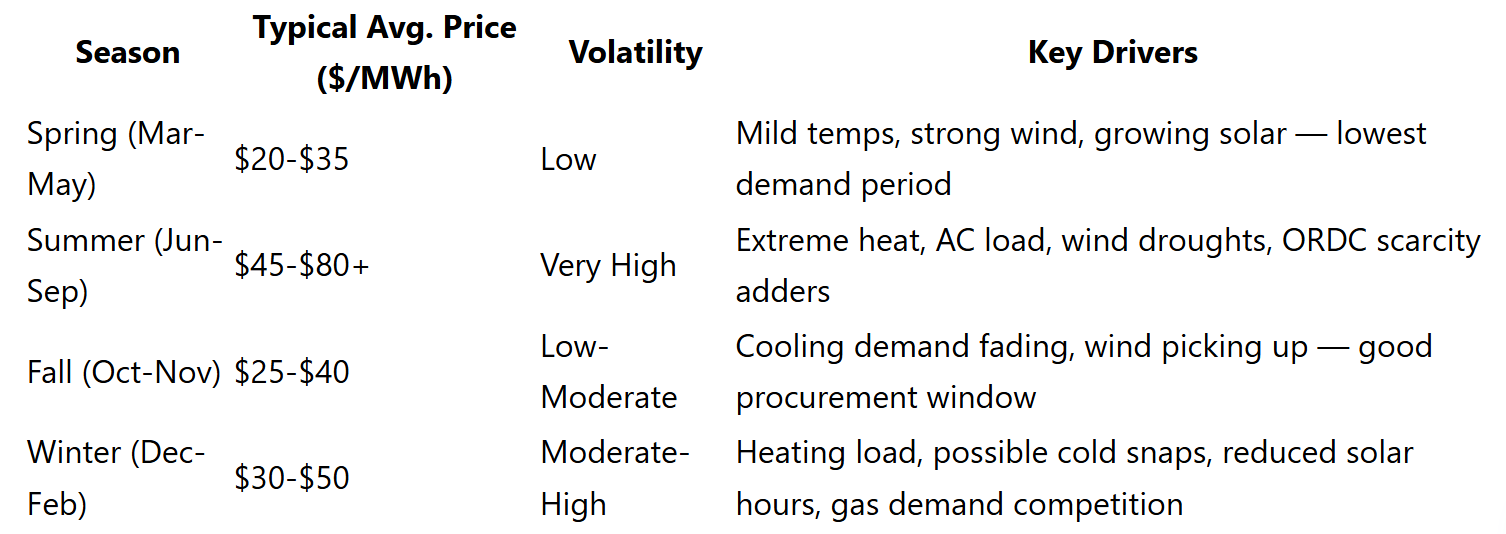
These ranges represent typical years. In a year with extreme heat, summer averages can easily exceed $100/MWh with individual hours hitting $5,000/MWh. In a mild summer with ample wind, averages might stay under $40/MWh. The spread between best-case and worst-case summer pricing is enormous — which is exactly why the risk premium embedded in fixed-rate contracts is highest for contracts covering summer months.
How Wholesale Prices Become Your Retail Rate
The wholesale market is where electricity is bought and sold between generators and REPs. Your retail rate is what your REP charges you after adding their costs and margin on top of wholesale prices. The path from wholesale to retail differs by contract type, and the components that make up the "gap" between wholesale and retail are worth understanding:
The Retail Cost Stack
Regardless of contract type, your all-in retail rate includes several cost layers beyond the wholesale energy price:
- Wholesale energy — The DAM/RTM price for electricity itself. Typically 40-55% of your total cost.
- TDU delivery charges — Regulated fees from your Transmission and Distribution Utility for using the wires. These are the same regardless of your REP. Typically 25-35% of total cost.
- Ancillary services — Reserve and grid stability costs allocated to all load. Typically 3-8% of total cost.
- REP margin and overhead — The REP's operating costs, customer service, billing, credit management, and profit. Typically 5-12% of total cost.
- Risk premium (fixed contracts only) — Compensation for the REP bearing price risk on your behalf. Varies by contract length, season, and market conditions.
- Renewable Energy Credits (RECs) — If your contract includes green energy, the cost of RECs is embedded.
- Taxes and fees — State and local taxes, system benefit fund, nuclear decommissioning.
Fixed-Rate Contracts
Your REP locks in a fixed retail rate by purchasing electricity forward (through the DAM, bilateral contracts, or financial hedges) to cover your expected consumption over the contract term. The fixed rate includes the expected average wholesale cost over your contract period, a risk premium for price uncertainty, the REP's operating costs and profit margin, and any applicable ancillary service costs.
This is why timing your fixed-rate contract matters — when forward wholesale prices are low, the embedded wholesale component of your fixed rate is lower, resulting in a better deal. A business locking a 24-month fixed rate in November when forwards are $35/MWh will get a structurally cheaper rate than one locking in July when forwards are $55/MWh, even if the REP margin is identical.
Index-Rate Contracts
Your rate directly tracks wholesale prices, plus a fixed adder from your REP. The adder covers the REP's margin, ancillary costs, and administrative overhead. Understanding the settlement mechanism (DAM vs. RTM, which settlement point, how congestion is handled) is critical when comparing index products.
Common index settlement structures include:
- Real-Time Settlement Point (RTSP) — Priced at your specific load zone's real-time LMP. Maximum exposure to locational price volatility.
- Real-Time Hub — Priced at the ERCOT Hub average (a weighted average of four trading hubs). Smooths out some locational congestion risk.
- Day-Ahead Zone — Priced at your load zone's DAM clearing price. More stable than real-time, but you carry imbalance risk between DAM position and actual consumption.
- Block + Index — A fixed block covers your baseload hours; only peak or off-peak deviations are settled at index. A hybrid approach. Read more about this in our guide to hedging electricity price volatility.
Hybrid Contracts
A portion of your load is priced at a fixed rate (hedged forward) while the remainder floats with an index. The fixed-to-variable ratio determines your blended exposure to wholesale market movements. Common splits are 70/30 or 80/20 fixed-to-index, giving you budget predictability on most of your consumption while retaining upside on the index portion during low-price periods.

REPs use sophisticated hedging strategies to convert volatile wholesale prices into the fixed, variable, and hybrid rates they offer commercial customers.
Locational Marginal Pricing: Why Location Matters
One of the most underappreciated aspects of ERCOT pricing is how much your location affects your cost. ERCOT has four main trading hubs (North, Houston, South, West) and over 10,000 individual settlement nodes. Your REP settles electricity at specific load zones or settlement points tied to your physical location on the grid.
The differences can be substantial:
- Houston Load Zone — Historically the highest-priced major zone due to concentrated demand, limited local generation relative to load, and congestion on import paths. Businesses here typically pay $2-$8/MWh more than the ERCOT-wide hub average.
- North Zone (Dallas/Fort Worth) — Generally close to the system average. Well-connected to both West Texas wind and Gulf Coast gas generation.
- South Zone (San Antonio/Austin) — Moderate pricing, benefits from proximity to both wind and solar resources. Growing solar capacity is pushing midday prices lower.
- West Zone — Lowest average prices due to abundant wind and solar generation. But congestion export constraints mean these low prices don't always reach eastern demand centers.
For multi-location businesses — retail chains, restaurant groups, warehouse operators — understanding per-location price variation allows smarter aggregation strategies. Sometimes it is cheaper to procure each location separately at its local settlement point rather than aggregate everything under one contract at a blended rate that cross-subsidizes expensive locations.
How to Read the Forward Curve
Professional energy buyers and brokers rely on the ERCOT forward curve — the market's consensus price for electricity delivery in future months and years. The forward curve is not a prediction; it is the price at which willing buyers and sellers agree to trade today for future delivery.
Key concepts for reading the forward curve:
- Contango — When future prices are higher than spot prices. Common heading into summer, reflecting anticipated heat-driven demand increases.
- Backwardation — When future prices are lower than spot prices. Can occur when current prices are spiking (temporary supply disruption) but the market expects normalization.
- Calendar Strip — The average price for a full calendar year of future delivery. A "Cal 2027 strip at $42/MWh" means the market expects an average wholesale price of $42/MWh across all hours of 2027.
- Peak vs. Off-Peak — Forward prices are often quoted separately for peak hours (weekdays 6 AM - 10 PM) and off-peak hours. The peak/off-peak spread reveals the market's expectation for daytime vs. nighttime price divergence.
When your broker tells you "the market looks favorable for locking in right now," they should be referencing specific forward curve levels compared to historical norms. Ask them: "Where is the 2027 calendar strip trading relative to the 5-year average?" That puts the recommendation in objective context.
Using Wholesale Market Knowledge Strategically
Understanding ERCOT wholesale dynamics gives you several strategic advantages:
Time Your Contract Signing
Forward wholesale prices follow seasonal patterns. They are typically lowest in fall and winter (October through February) when mild weather reduces demand and strong wind generation keeps supply ample. Signing a fixed-rate contract during these periods captures lower wholesale prices in your rate. Avoid signing during June-August when forward prices embed summer heat risk premiums.
The optimal signing window also depends on contract start date. If you are renewing a contract that expires in March, begin shopping in October-November — 3-5 months ahead. If your contract expires in August, start shopping in March-April before summer premiums build. Read our guide to contract expiration for what happens if you miss this window.
Evaluate Index vs. Fixed Intelligently
If you understand the wholesale price drivers, you can make more informed decisions about rate structure. If gas prices are elevated and summer reserves look tight, the market is pricing in risk — a fixed rate locks you in before potential spikes. If gas is cheap and reserve margins are comfortable, index pricing may deliver lower costs because the risk premium embedded in fixed rates exceeds the actual volatility.
A useful framework: compare the fixed-rate offer to the current forward strip for the same period. If the REP's fixed rate is significantly above the strip, they are embedding a large risk premium. If it is close to the strip, the premium is thin. Neither is inherently better — a thin premium in a volatile market may mean the REP is underpricing risk, and you could benefit. A large premium during calm markets may mean you are overpaying for insurance you don't need.
Negotiate From a Position of Knowledge
When you understand that a REP's fixed rate is built from a wholesale forward price plus margin, you can challenge the margin component. If current wholesale forwards for a 24-month strip are $45/MWh and a REP offers you $85/MWh retail, you know the embedded margin is roughly $40/MWh (after accounting for TDU pass-throughs and ancillary costs). Is the REP's actual adder $8/MWh or $18/MWh? Your energy broker can decompose competing offers to reveal which REP is pricing most aggressively.
Specific leverage points in negotiations:
- Volume commitment — Higher kWh volume earns tighter margins. A facility consuming 500,000 kWh/month has more leverage than one at 50,000 kWh/month.
- Load profile quality — High load factor means flatter, more predictable consumption. REPs can hedge this more cheaply, which should translate to lower margins.
- Credit quality — Strong financials reduce the REP's credit risk. Some REPs offer pricing tiers based on credit score or years in business.
- Multi-site aggregation — Bundling multiple meters under one contract gives volume leverage and simplifies the REP's operations, justifying a better rate.
- Contract term flexibility — Offering to take a longer term (36 months vs. 12) gives the REP more revenue certainty. This should translate to a margin concession.
Manage Index Exposure Actively
If you are on an index rate, knowing when wholesale prices are likely to spike (summer afternoons, cold winter mornings, low-wind periods) allows you to shift flexible loads to lower-cost hours. Even modest load shifting — running energy-intensive processes overnight rather than during afternoon peaks — can meaningfully reduce your costs on an index product. Manufacturing facilities and data centers with operational flexibility are best positioned to capture this value.
Specific index management tactics include:
- Pre-cooling buildings before afternoon price peaks (run HVAC hard from 5-10 AM when prices are low, coast through the 2-6 PM peak)
- Scheduling batch processes overnight — laundry cycles at hotels, dishwasher runs at restaurants, production shifts at factories
- Setting price-triggered curtailment alerts — if your building management system can receive external signals, you can automatically shed non-critical loads when prices exceed a threshold
- Monitoring ERCOT weather and wind forecasts — when a wind drought is forecast to coincide with 100°F+ heat, consider shifting or reducing discretionary loads proactively
Key ERCOT Market Resources
ERCOT publishes extensive market data that is freely available:
- Real-Time Market Prices — Published every 5 minutes for all settlement points. Available on the ERCOT website dashboard.
- Day-Ahead Market Results — Published daily with hourly LMPs for the following day.
- Capacity, Demand, and Reserves (CDR) Report — Published seasonally with forward-looking reserve margin projections. This is the single most important forward-looking document for anticipating summer pricing conditions.
- System-Wide Demand Forecast — Published hourly with 7-day rolling forecasts.
- Wind and Solar Generation Forecasts — Published with real-time and short-term forecasts of renewable output.
- Fuel Mix Report — Real-time breakdown of which generation types (gas, wind, solar, coal, nuclear) are currently serving load.
- Market Notices — Alerts about grid conditions, conservation appeals, and emergency operations. Subscribing to these gives early warning of tight conditions.
While most business owners will not monitor these data feeds directly, your energy broker should be using this information to advise you on contract timing and structure. If your broker cannot explain how current wholesale market conditions affect the rate they are recommending, find a broker who can.
Common Misconceptions About ERCOT Pricing
Several widely held beliefs about the Texas wholesale market deserve correction:
- "The wholesale price is what I should be paying." — No. Wholesale is just the energy component. Your all-in rate includes TDU delivery, ancillary services, REP margin, and taxes. Comparing a $40/MWh wholesale price to your $90/MWh retail rate does not mean your REP is gouging you — the gap is mostly regulated pass-through costs.
- "Index rates are always cheaper than fixed." — Over long periods in calm markets, index rates often beat fixed rates by avoiding the risk premium. But a single summer price spike can erase years of savings. Index is not cheaper — it is differently distributed. Some years you win big, some years you lose big.
- "ERCOT prices are unpredictable." — Individual 5-minute intervals are unpredictable. But seasonal patterns, gas-price correlations, and weather-driven demand are well-understood and reasonably forecastable. The tail risk (extreme events) is unpredictable; the base case is not.
- "Renewable energy is making electricity free." — Wind and solar do suppress prices during high-output hours. But they also create steeper ramps, more volatile net demand, and higher capacity costs as conventional generators need higher margins for fewer running hours. The net effect on total cost is complex, not simply downward.
The Bottom Line
ERCOT wholesale pricing is the foundation of every retail electricity rate in Texas. When you understand the mechanics — how the day-ahead and real-time markets work, what drives prices, how LMPs decompose into energy, congestion, and loss components, and how wholesale costs flow through to your retail rate — you move from being a passive price-taker to an informed buyer.
You do not need to become a wholesale market trader. But understanding these dynamics gives you the vocabulary and framework to ask better questions, evaluate proposals critically, and time your procurement decisions to capture favorable market conditions. The difference between a business that understands wholesale pricing and one that does not can easily be 10-20% on annual electricity costs — tens of thousands of dollars for a mid-size commercial operation.